
I have had my LG 27" 4K 160hz for many years now, but I would really like af faster 240hz monitor.
But I donk think they are made? Why did they stop at 4K@160hz for LCD´s?
I have had a OLED 240hz as a test..but I thought it was too dark in SDR (not using HDR)
I like LCD better for competitve gaming.
why are there no 27" 4K 240hz LCD´s
-
kyube

- Posts: 933
- Joined: 29 Jan 2018, 12:03
Re: why are there no 27" 4K 240hz LCD´s
https://tftcentral.co.uk/news/lg-27g850 ... hz-supportmbm wrote: ↑19 Mar 2025, 00:03I have had my LG 27" 4K 160hz for many years now, but I would really like af faster 240hz monitor.
But I donk think they are made? Why did they stop at 4K@160hz for LCD´s?
I have had a OLED 240hz as a test..but I thought it was too dark in SDR (not using HDR)
I like LCD better for competitve gaming.
This exists and is available for purchase.
evaluating xhci controller performance | audio latency discussion thread | "Why is LatencyMon not desirable to objectively measure DPC/ISR driver performance" | AM4 / AM5 system tuning considerations | latency-oriented HW considerations | “xhci hand-off” setting considerations | #1 tip for electricity-related topics | ESPORTS: Latency Perception, Temporal Ventriloquism & Horizon of Simultaneity | good lcd backlight strobing implementation list | display vs gpu scaling
-
purplemelon1
- Posts: 108
- Joined: 16 Nov 2024, 04:13
Re: why are there no 27" 4K 240hz LCD´s
Took a look at the 4k 32 inch lg displays. Their high end 144hz ips displays have like a 65% gtg compliance. Including that 1440p 240hz one. Now my understanding of gtg is pretty bad but if the uplift in clarity is only going to be like 10% switching from 144hz to 240hz. Why would you want to bother.
Well then again the monitor linked has 480hz. So.... I guess maybe actually launching and having it reviewed is worthwhile?
If that ips black still has a gtg compliance of like 70% in the 480hz mode. What does that actually mean for it's clarity?
Well then again the monitor linked has 480hz. So.... I guess maybe actually launching and having it reviewed is worthwhile?
If that ips black still has a gtg compliance of like 70% in the 480hz mode. What does that actually mean for it's clarity?
-
kyube
- Posts: 933
- Joined: 29 Jan 2018, 12:03
Re: why are there no 27" 4K 240hz LCD´s
https://blurbusters.com/gtg-versus-mprt ... -response/purplemelon1 wrote: ↑20 Mar 2025, 01:55Took a look at the 4k 32 inch lg displays. Their high end 144hz ips displays have like a 65% gtg compliance. Including that 1440p 240hz one. Now my understanding of gtg is pretty bad but if the uplift in clarity is only going to be like 10% switching from 144hz to 240hz. Why would you want to bother.
Well then again the monitor linked has 480hz. So.... I guess maybe actually launching and having it reviewed is worthwhile?
If that ips black still has a gtg compliance of like 70% in the 480hz mode. What does that actually mean for it's clarity?
Total motion clarity (MPRT) is a sum of 2 important factors:
Display scan-out (refresh rate) + G2G response times
If the G2G response times (ALL possible combinations in 0-255 range) are all below the refresh rate (4.17ms or 2,083ms in this case), then you have a perfect representation of the refresh rate. This is the case with OLED displays, as all of their G2G transitions are <1ms, which would easily allow for a 1kHz display scan-out without any smearing due to slower G2G response times.
To be specific, the actual refresh rate increases are what govern total motion clarity benefits the most in sample & hold displays.
These 2 reviews might be of use to you:
https://www.youtube.com/watch?v=sUwSREo7wuk
https://www.bilibili.com/video/BV1AafoYsE81/
The LG 27G850A is currently the best display ergonomics experience on desktop displays due to it's pixel density and decent refresh rate.
OLED being close 2nd, but not 1st due to text rendering issues & light flicker.
evaluating xhci controller performance | audio latency discussion thread | "Why is LatencyMon not desirable to objectively measure DPC/ISR driver performance" | AM4 / AM5 system tuning considerations | latency-oriented HW considerations | “xhci hand-off” setting considerations | #1 tip for electricity-related topics | ESPORTS: Latency Perception, Temporal Ventriloquism & Horizon of Simultaneity | good lcd backlight strobing implementation list | display vs gpu scaling
-
purplemelon1
- Posts: 108
- Joined: 16 Nov 2024, 04:13
Re: why are there no 27" 4K 240hz LCD´s
Hm. Thanks for the response. Apparently the response times are no different than the other 1440p 144hz displays. Meaning you should expect the coherence of 100fps. Except this is a 480hz display so what """ does that actually mean.kyube wrote: ↑20 Mar 2025, 11:00https://blurbusters.com/gtg-versus-mprt ... -response/
Total motion clarity (MPRT) is a sum of 2 important factors:
Display scan-out (refresh rate) + G2G response times
If the G2G response times (ALL possible combinations in 0-255 range) are all below the refresh rate (4.17ms or 2,083ms in this case), then you have a perfect representation of the refresh rate. This is the case with OLED displays, as all of their G2G transitions are <1ms, which would easily allow for a 1kHz display scan-out without any smearing due to slower G2G response times.
To be specific, the actual refresh rate increases are what govern total motion clarity benefits the most in sample & hold displays.
These 2 reviews might be of use to you:
https://www.youtube.com/watch?v=sUwSREo7wuk
https://www.bilibili.com/video/BV1AafoYsE81/
The LG 27G850A is currently the best display ergonomics experience on desktop displays due to it's pixel density and decent refresh rate.
OLED being close 2nd, but not 1st due to text rendering issues & light flicker.
I have read the faq many times over. I do not really get it. I do not know how to convert that knowledge into say an rtings review. Like using the very above as an example. Would having a mprt (response time) of 10ms mean a gtg compliance of 20% because you need 2ms?
Does 2ms gtg automatically mean you have to add 2ms to 4ms mrpt because 480hz needs 2 seconds of display time? Giving you an equal amount of information visually as 240hz oled? Because the 480hz (or lower on lower monitors) would still be a real refresh rate. Even if smearing takes out pixel information that should be visible.
I don't know. I need more graphs maybe. I tried the testufo gtg example on a 2011 ccfl display i have and.... It really does not look that different than on an amoled phone. I don't think that is how it is suppose to work.
-
mbm
- Posts: 13
- Joined: 24 Jan 2020, 07:03
Re: why are there no 27" 4K 240hz LCD´s
it could be an interesting monitor. BUT if the pricetag is too high compared to OLED I dont think it would sell.
-
kyube
- Posts: 933
- Joined: 29 Jan 2018, 12:03
Re: why are there no 27" 4K 240hz LCD´s
purplemelon1 wrote: ↑21 Mar 2025, 03:17Hm. Thanks for the response. Apparently the response times are no different than the other 1440p 144hz displays. Meaning you should expect the coherence of 100fps. Except this is a 480hz display so what """ does that actually mean.
I have read the faq many times over. I do not really get it. I do not know how to convert that knowledge into say an rtings review. Like using the very above as an example. Would having a mprt (response time) of 10ms mean a gtg compliance of 20% because you need 2ms?
Does 2ms gtg automatically mean you have to add 2ms to 4ms mrpt because 480hz needs 2 seconds of display time? Giving you an equal amount of information visually as 240hz oled? Because the 480hz (or lower on lower monitors) would still be a real refresh rate. Even if smearing takes out pixel information that should be visible.
I don't know. I need more graphs maybe. I tried the testufo gtg example on a 2011 ccfl display i have and.... It really does not look that different than on an amoled phone. I don't think that is how it is suppose to work.
This is not how it works.Would having a mprt (response time) of 10ms mean a gtg compliance of 20% because you need 2ms?
G2G response times and MPRT are not the same thing.
MPRT is a visual target, the actual time interval a target is visible for on the screen.
https://blurbusters.com/gtg-versus-mprt ... -response/
Refresh rate compliance is the percentage of all recorded values which are equal or under the display's scan-out.
Display scan-out (refresh rate) is still 240hz or 480hz, which will net you lower total persistence, regardless of response times.
You also substantially lower the total display latency by having a faster scan-out.
CRT's used to be <1ms persistence (MPRT), regardless of refresh rate, due to employing strobing (hiding the blur under flicker)
This is why most people in the past thought 60FPS was fine, since it was low persistence regardless of the content's frame rate.
Sample & hold (LCD & OLED) doesn't work that way, it requires you to push the refresh rate >1000Hz while also driving the frame rate to benefit reap motion clarity benefits (lower persistence / time on screen)
Source: @Discorz

Source: Bilibili review

Note: this is very likely at 960pps, which isn't fast enough for these high refresh rates.
This second image should show you how a pure MPRT limit (OLED) looks like, meaning G2G response times are below the display scan-out (refresh rate)
Notice how LCD's of equal or higher refresh rate than the OLED are blurrier? That is because of G2G response times adding the "smear" effect, but it's still mostly limited by the refresh rate.
To best evaluate RTINGS data, opt for the updated 2.0 testing methodology and take a look at raw response time graphs.
This should reveal you the true nature of each transition they record.
G2G response time heatmaps are also OK, but most reviewers don't make them as granular as possible.
This video should help you understand the data better.
I hope this answers some of your dilemma's.
evaluating xhci controller performance | audio latency discussion thread | "Why is LatencyMon not desirable to objectively measure DPC/ISR driver performance" | AM4 / AM5 system tuning considerations | latency-oriented HW considerations | “xhci hand-off” setting considerations | #1 tip for electricity-related topics | ESPORTS: Latency Perception, Temporal Ventriloquism & Horizon of Simultaneity | good lcd backlight strobing implementation list | display vs gpu scaling
-
purplemelon1
- Posts: 108
- Joined: 16 Nov 2024, 04:13
Re: why are there no 27" 4K 240hz LCD´s
Thanks for the detailed reply. I see where the issue lies.
https://blurbusters.com/wp-content/uplo ... z-oled.gif
If just going by this photo. I now understand that 120hz is 120hz smoothness no matter what.
The question is why did chief say that the average display has a 1.5x clarity boost over 60fps while oled has a flat 2x boost?
Under https://blurbusters.com/massive-upgrade ... or-office/
I would also hope that chief himself can edit the point "GtG Needs Be Zero. GtG Under Refreshtime Is Not Enough." To clarify what gtg needs to be 0 for. Do you really need 0 gtg for a 60hz display? 75hz?
Going back to the 480hz having 10ms response time (i assume gtg now). Would that not mean in a 960ppx speed. Instead of having 2 pixels of blur, would you not have 10 pixels being blurred?
Even is you now have 5 samples instead of 2. Each stair case representing a sample/frame ? https://blurbusters.com/wp-content/uplo ... dhold2.gif
https://blurbusters.com/wp-content/uplo ... z-oled.gif
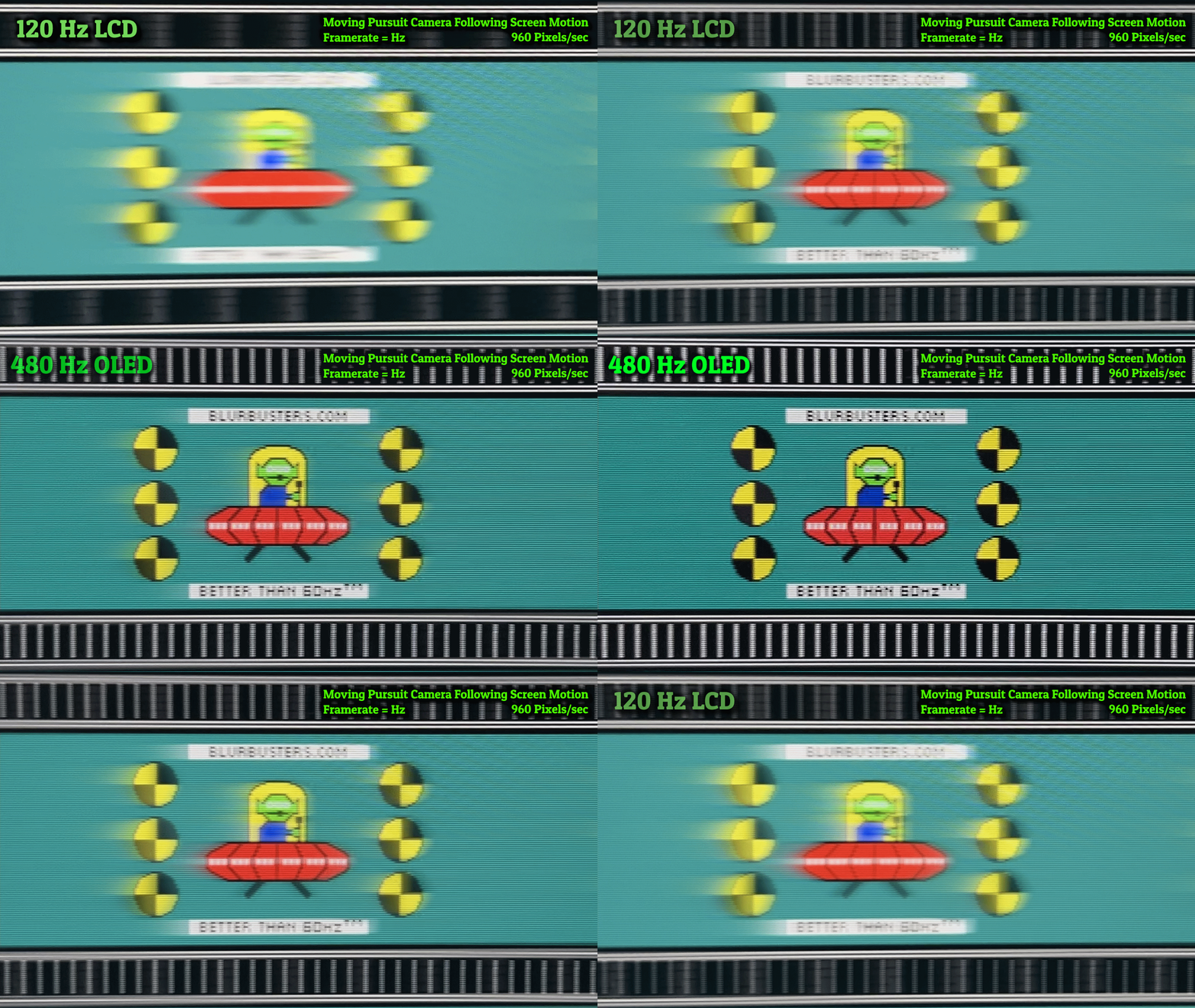
If just going by this photo. I now understand that 120hz is 120hz smoothness no matter what.
The question is why did chief say that the average display has a 1.5x clarity boost over 60fps while oled has a flat 2x boost?
Under https://blurbusters.com/massive-upgrade ... or-office/
I would also hope that chief himself can edit the point "GtG Needs Be Zero. GtG Under Refreshtime Is Not Enough." To clarify what gtg needs to be 0 for. Do you really need 0 gtg for a 60hz display? 75hz?
Going back to the 480hz having 10ms response time (i assume gtg now). Would that not mean in a 960ppx speed. Instead of having 2 pixels of blur, would you not have 10 pixels being blurred?
Even is you now have 5 samples instead of 2. Each stair case representing a sample/frame ? https://blurbusters.com/wp-content/uplo ... dhold2.gif
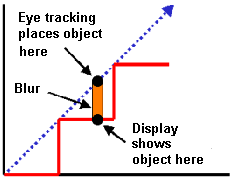
-
kyube
- Posts: 933
- Joined: 29 Jan 2018, 12:03
Re: why are there no 27" 4K 240hz LCD´s
The reason he mentioned those multiplier values is precisely due to G2G response times.purplemelon1 wrote: ↑21 Mar 2025, 22:58https://blurbusters.com/wp-content/uplo ... z-oled.gif
If just going by this photo. I now understand that 120hz is 120hz smoothness no matter what.
The question is why did chief say that the average display has a 1.5x clarity boost over 60fps while oled has a flat 2x boost?
Under https://blurbusters.com/massive-upgrade ... or-office/
Those are Chief's subjective, visual estimates on how an average LCD scales with refresh rate increases compared to OLED
No, you just need the values to be below the refresh rate (scan-out), which would be 16,67ms for 60hz.purplemelon1 wrote: ↑21 Mar 2025, 22:58I would also hope that chief himself can edit the point "GtG Needs Be Zero. GtG Under Refreshtime Is Not Enough." To clarify what gtg needs to be 0 for. Do you really need 0 gtg for a 60hz display? 75hz?
On LCD, each type has some strengths and weaknesses
For example:
TN's excel in fall times, which are white-to-black transition, such as RGB(255,255,255) – RGB(0,0,0)
They are not good at rise times, which are black-to-white transitions, such as RGB(0,0,0) – RGB(255,255,255)
IPS are the opposite, excelling in rise times but faltering in fall times.
VA's struggle when darker shades of grays appear, which is commonly referred to as “black smearing”
OLED's, due to their <1ms G2G response times, do not suffer from the G2G limitations that LCD does, hence why they scale exactly how sample & hold should scale in theory.
The G2G response times heatmap that is shown in that LG review video are not gamma corrected, I wouldn't take them to heart to be precise.purplemelon1 wrote: ↑21 Mar 2025, 22:58Going back to the 480hz having 10ms response time (i assume gtg now). Would that not mean in a 960ppx speed. Instead of having 2 pixels of blur, would you not have 10 pixels being blurred?
Even is you now have 5 samples instead of 2. Each stair case representing a sample/frame ? https://blurbusters.com/wp-content/uplo ... dhold2.gif
This is a good question, but I don't know the answer to it. Maybe Chief or someone else can chime in.
evaluating xhci controller performance | audio latency discussion thread | "Why is LatencyMon not desirable to objectively measure DPC/ISR driver performance" | AM4 / AM5 system tuning considerations | latency-oriented HW considerations | “xhci hand-off” setting considerations | #1 tip for electricity-related topics | ESPORTS: Latency Perception, Temporal Ventriloquism & Horizon of Simultaneity | good lcd backlight strobing implementation list | display vs gpu scaling