styhk wrote: ↑19 Dec 2025, 06:50
https://tftcentral.co.uk/wp-content/upl ... _1_new.png
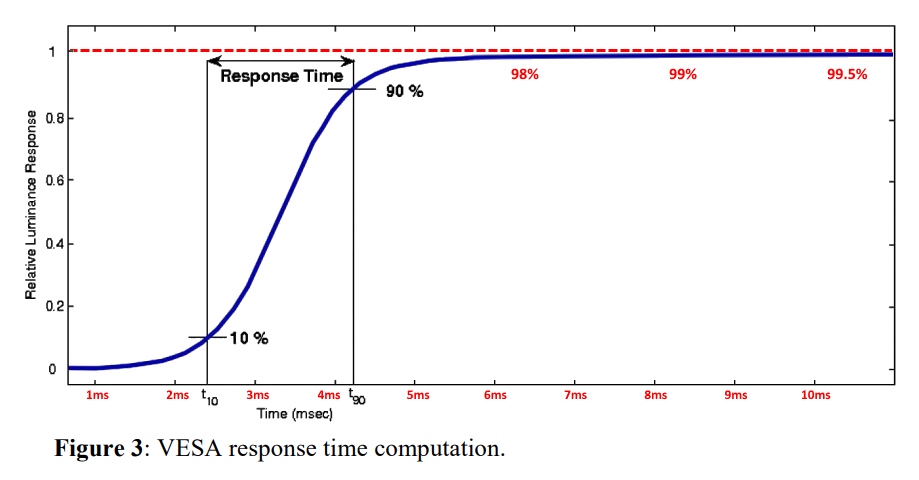
Ultra Fast IPS panels can do average 2.2ms GtG with most ranges within 2ms, shouldn't that be enough for 500Hz?
With those newer backlight which has LED strip on both sides, I assume there would be barely any crosstalk?
1.) Extremely far from it

The PG27AQN ("Ultra Fast IPS")'s M270DAN10.0 is only compliant ("OLED-like") at it's 240Hz setting. It falls apart once you get into it's 360Hz mode.
There isn't a single LCD display which has the necessary G2G < MPRT target requirement for "truthful" refresh rate representation.
2.) The "LED strips both sides" refers to manifacturers' implenting a
rolling scan backlight strobing solution as opposed to a
global scan backlight strobing solution
Found on panels such as on TNs' (Dyac2, ELMB2, MBR+) or on certain IPS MiniLED's (e.g.: MSI 4K model, E16M)
styhk wrote: ↑19 Dec 2025, 07:04
Smoothness and motion clarity are totally different.
My understanding:
Smoothness = how coherence motion looks, higher refresh rate always look smoother even GtG is slow
Motion clarity = How clear it looks when flicking around
This is why these ambigious terms are misleading
In terms of eye-tracked motion performance (part of a umbrella term I've personally chosen — "dynamic image quality", which encompasses both fixed-gaze & eye-tracked scenarios), it's highly dependant on the
speed of the digital object moving on-screen.
"Smoothness" is a term used coloquially to describe sample rate.
styhk wrote: ↑19 Dec 2025, 07:04
Human eyes doesn't work exactly like a camera that's why I think people are too serious about UFO test.
This is a somewhat misleading claim.
Human eyes in fast-paced esports games (Apex, Rocket League, OW2, Quake, racing games), especially in games with a locked frame rate benefit
tremendously from eye-tracked motion performance.
This is the whole purpose of the TestUFO pursuit photographs... testing that particular part of the dynamic image quality of a display.
I do agree that the particular G2G values that TestUFO uses may not be representative of how the panel will "feel" or "look like" in-game, as LCD's can be either good at rise times (IPS) or fall times (TN) or have both somewhat equally well done (VA's such as the INNOCN 27G1S)
It's foolish to claim that TestUFO results shouldn't be taken seriously, as they can reveal a lot about a panel's characteristics without resorting to the use of probing the internals of a display using external tools (oscilloscope + light probe) when done at correct UFO speeds.
styhk wrote: ↑19 Dec 2025, 07:04
LCD's motion clarity are slighty better at lower refresh rate due to OLED's judder effect.
"Slightly better at lower refresh rate"?
What? Better at doing what? Displaying a digital image on a electronic visual display?
No. OLED is the only truthful representation
The "judder effect" is caused by the too low sample/refresh rate of the content & therefore the screen as well (as this entire discussion assumes frame rates being equal or higher than the display's refresh rate/vertical frequency)
styhk wrote: ↑19 Dec 2025, 07:04
At 360Hz+ OLED just win no matters what.
"Wins" at what?
Sample & hold representation of the refresh rate when FPS>=Hz? Yes.
Eye-tracked motion performance in the vast majority of games/workloads when FPS=Hz? Very insufficient, considering that 360px/s is
very slow
"Good" backlight strobing (<1ms MPRT) still has a valid place, especially in 100-240Hz range where the vast majority of games are played in nowadays.
styhk wrote: ↑19 Dec 2025, 07:04
I have way better experience on 360Hz OLED compared to 540Hz strobbed ULMB2 LCD.
Input lag is lower due to extremely low GtG and motion clarity is better probably because of the glossy coating, no ghosting, double imaging bs.
Yes, generally, backlight strobing is somewhat of a hinderance from a physiological perspective (due to flicker), the added processing latency & use of KSF WLED backlight (on your particular model)
Sample & hold, if you're satisfied with / ignorant of the "smear" (due to the relatively low frame rate target of 360), on OLED is better.
styhk wrote: ↑19 Dec 2025, 07:04
I'm happy with my Philips 500Hz QD-OLED, Hopefully there will be 1080p high refresh rate OLED next year
I would've bought the ASUS 2K Dual mode 540/720Hz but 720Hz only works at 720p so it' basically useless. I thought 720Hz would work at 1080p, What a disappointment.
You can set your image resolution to 1080p and rely on 'No scaling' to achieve the desired viewport while playing.