
New to the forum, please beat me up if i am repeating what was answered earlier, but i could not find it off the top of my head searching the forum.
So, for some time now, new DLP projectors offer 240Hz at 1080p native Display resolution. And there was was just a thread discussing how the sequential flashing does have different blur impact than solid state display technologies.
But my question is more related to the latest new "feature" in DLP, the rolling buffer, made possible through Texas Instruments latest DLP controller chip series DLPC854x5 (8445, 8455).
The way TI sells this is that it brings down latency from 4msec (1/240) to below 1 msec at the top of the screen. And i wonder if anyone here would venture to guess if this reduction in latency is a relevant improvement, and if so how. Purely from the gaming perspective i wouldn't want to believe that good gamers can create a noticable faster reaction with the 1msec on top of screen (still 4 msec on bottom) vs 4msec everywhere (double buffering). But i am no action-game player, hence the question.
There is also the much more annoying issue that these projectors claim to bring down 4k@60 latency from 16msec to measured 2msec latency at the top of the screen because of the rolling buffer, but that latency is only 25% true, because these projectors render 4k resolution images sequentially as 4 1080p images each of which has a quarter of the 4k image pixels and each is projected by slightly shifting the image by 1/2 pixel horizontal/vertical. So even the top of screen is only fully displayed after 12msec, not 2. And the whole process introduces also new rainbow effect if done incorrectly. And RBE of course is for DLP the worst version of blur (IMHO).
So i am quite annoyed by this new technology by TI and would at least like to know if any gamers will actually be more happy with it than with the prior technology (double buffer) used. So far i have seen no convincing evidence of that.
DLP with rolling buffer and gaming/blur/RBE
-
Chief Blur Buster

- Site Admin
- Posts: 12284
- Joined: 05 Dec 2013, 15:44
- Location: Toronto / Hamilton, Ontario, Canada
- Contact:
Re: DLP with rolling buffer and gaming/blur/RBE
It's not new... Just brings DLP to level playing field.te36 wrote: ↑28 Mar 2026, 02:50New to the forum, please beat me up if i am repeating what was answered earlier, but i could not find it off the top of my head searching the forum.
So, for some time now, new DLP projectors offer 240Hz at 1080p native Display resolution. And there was was just a thread discussing how the sequential flashing does have different blur impact than solid state display technologies.
But my question is more related to the latest new "feature" in DLP, the rolling buffer, made possible through Texas Instruments latest DLP controller chip series DLPC854x5 (8445, 8455).
The way TI sells this is that it brings down latency from 4msec (1/240) to below 1 msec at the top of the screen. And i wonder if anyone here would venture to guess if this reduction in latency is a relevant improvement, and if so how. Purely from the gaming perspective i wouldn't want to believe that good gamers can create a noticable faster reaction with the 1msec on top of screen (still 4 msec on bottom) vs 4msec everywhere (double buffering). But i am no action-game player, hence the question.
LCD and OLED use rolling buffers, so equalizing with LCD & OLED is very good.
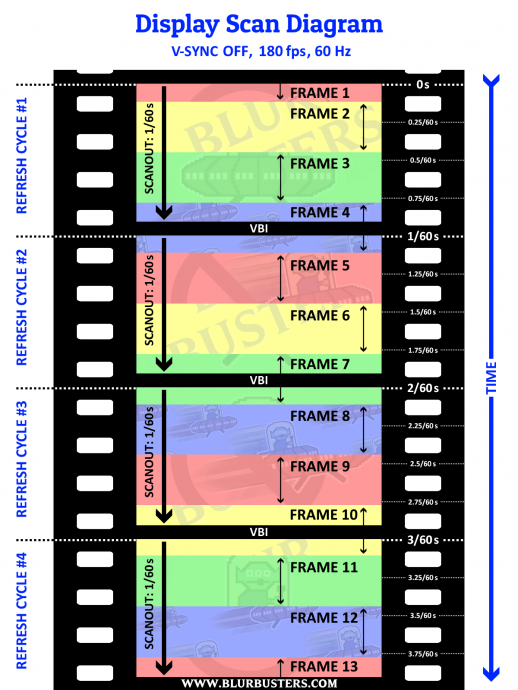
Remember, VSYNC OFF is also a metaphorical rolling-buffer because of mid-refresh splicing of new frames, so MIDDLE=TOP and BOTTOM=TOP. So 1ms=1ms=1ms instead of 4ms=4ms=4ms, if you're running at sufficiently high frame rates.
VSYNC ON is a +[0...refreshtime] adder, for whole refresh cycle. Average 1/2 refresh cycle lag.
VSYNC OFF is a +[0...frametime] adder, for frameslice (between two tearlines). Average 1/2 frametime lag.
TL;DR
- Whole refresh cycle is a lag gradient
- But during VSYNC OFF, frameslice is the lag gradient. And you can have many frameslices per Hz.
So all pixels win, for the typical esports VSYNC OFF use case.
To visualize framerates above Hz during VSYNC OFF:
Head of Blur Busters - BlurBusters.com | TestUFO.com | Follow @BlurBusters on: BlueSky | Twitter | Facebook

Forum Rules wrote: 1. Rule #1: Be Nice. This is published forum rule #1. Even To Newbies & People You Disagree With!
2. Please report rule violations If you see a post that violates forum rules, then report the post.
3. ALWAYS respect indie testers here. See how indies are bootstrapping Blur Busters research!