Re: Advantages of high refreshrates?
Posted: 09 May 2020, 09:15
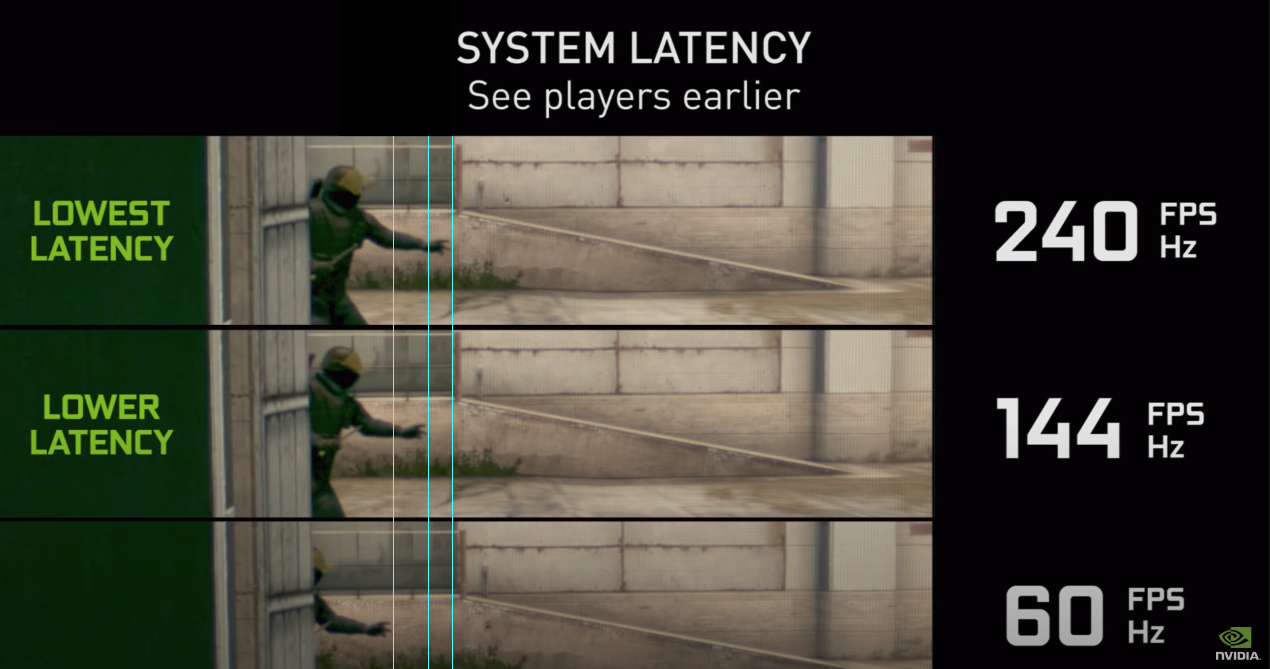
Yeah but considering the same setup except different monitors. Same mouse, same graphics card, playing in the same game with exact same ISP but one is on a 144Hz monitor and another on a 240Hz monitor. Then the difference is only like 3 or 4 milliseconds right between 144Hz and 240Hz? Its then i have a hard time believing a 240Hz player would see you first than someone on a 144Hz monitor because of human reaction times is much greater than 3-4ms. Sorry for long discussion btw, appreciate your answersjorimt wrote: ↑09 May 2020, 08:54To be entirely fair to that comparison screen, the fact that 240Hz looks like way less of a reduction over 144Hz vs 144Hz over 60Hz in that particular test scenario is a bit of an optical illusion; if we start from the fingertips and measure the difference in distance, the delivery speed increase of 240Hz over 144Hz is still 2/3rds of the delivery speed increase of 144Hz over 60Hz:
E.g. if they had captured that screen starting with the hand appearing from behind the wall first, nearly the entirety of the hand would have appeared at 240Hz before 144Hz even started to show the very tip of the fingers (if that).
I'm not entirely certain where you're getting that 10ms number, but, again, let's say someone has a 200ms reaction time. You add 10ms to that, and you now effectively have a higher reaction time maximum. Then, add, say (pulling these numbers completely out of my hat; for example only), 8ms from your mouse, 5ms from your monitor, 15ms+ from the game engine buffering (etc), and you have now artificially increased your max average reaction time by a fair amount.Avean wrote: ↑09 May 2020, 03:51Like you say, research show reaction times below 100ms. But we are talking about less than 10ms of difference in this example between 144Hz and 240Hz. The idea that a player is gonna take advantage of this when its happening so extremely fast. Its just a few milliseconds ... Tons of other benefits of course, but that you have an advantage in seeing the enemy first
Look, I personally don't care about the difference between 144Hz and 240Hz either. It is of my opinion that such small decreases in ms only help players that are already good at the game. In other words, if you suck at the game, it probably isn't those extra few ms that are making you perform so poorly, and/or you have a really, really bad ISP.
That, and we're all free to think that 240Hz or higher "has [little to] no advantage," and to stick to our 144Hz display (I will also say here there can still be a slight justification to this, not because 240Hz isn't better, but because so few 240Hz panels perform quite as well with overdrive as 144Hz displays, but this is another subject, and something that is getting better). That said, again, it doesn't mean these advances are not "worth" it, just because some of us can't imagine any value to some aspects of the posed reductions.
I'll say it again; refresh rate is an artificial limitation, motion blur is an artificial limitation, input lag is an artificial limitation. The fact that we're event talking about this shows how far displays have to go before refresh rate discussions become obsolete. Ideally, refresh rates and achievable framerate should ultimately become so high that it's not even something the consumer thinks about any more.
But we're not there yet...
 Just have a habit of needing to know if my theories are correct hehe.
