axaro1 wrote: ↑13 May 2020, 09:32
800DPI with 15sens should be the same as 1600 with 7.5sens(I checked a sensitivity calculator), that's why I'm thinking it must be placebo.
Except when you mouse slowturn.
1. Test 400dpi at 30sens.
2. Test 1600dpi at 7.5sens.
They both turn at same speeds (if you have good sensor, clean mouse feet, and 1600dpi-compatible mousepad). 1600dpi shouldn't feel worse if you maintain or upgrade your sensor/feet/pad/etc.
Huge benefit for mouse slow turns and slow pans near territory of 1000 pixels/second movements
But the magic is when you mouse slowturn; like at TestUFO speeds -- 240 pixels/sec or 480 pixels/sec or 960 pixels/sec. That starts aliasing against the lowness of 400dpi, creating a step-step effect that feels like a reduced framerate and/or jitteriness of mouse slowturns. Try turning slowly as if you're turning only one screenwidth per second, or one-half screenwidth per second.
For mouse slowturns, will see a BIG difference between 400dpi and 1600dpi. At 400dpi, it steps-steps coarsely (not TestUFO-smooth). But at 1600dpi, it pans smoothly (more TestUFO-smooth).
Low Mouse DPI limits the "effective frame rate" of the whole-screen panning of your mouse slow-moves
If you move your mouse over 1 inch to turn 960 real-world screen-width pixels or even 1920 real-world screen-width pixels, 400dpi won't hit all pixels. Only 400 of them! It looks like a lower frame rate. So your turning/panning framerate literally is steppier, with a step-step effect (as if it was a lower frame rate during very slow and medium speed mouse movement). This kills the motion blur reduction (LightBoost, PureXP, ULMB, whatever) since you're not getting the necessary fps=Hz during mouse slowturns to keep everything CRT-clear
during mouse slowturns.
In fact, double-images can occur during strobing with mouse slowturns, e.g. 1 inch going onscreen 800 pixels/sec, creating a half-frame-rate situation with a 400dpi mouse, creating double-images in PureXP+ during an onscreen 800 pixels/sec mouseturn at 400dpi
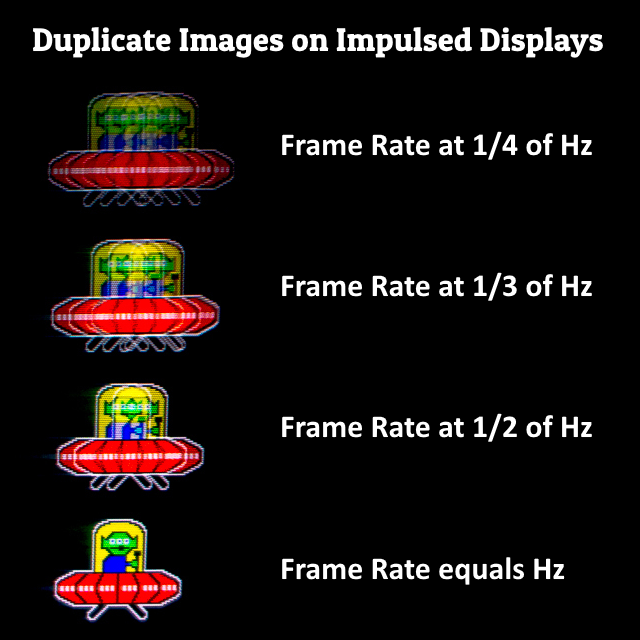
It can go ugly -- triple images during an onscreen 1200 pixels/sec mouseturns/pan at 400dpi, quadruple images during an onscreen 1600 pixels/sec mouseturn/pan at 400dpi. Assuming mouse smoothing is turned off, of course.
if you are panning in MOBA or RTS game -- slowpans will be much smoother at higher mouse DPI.
Fix your DPI and make it TestUFO smooth, baby!
Fix your DPI and say goodbye to LightBoost/PureXP/ULMB/etc double-images!
(As long as you can maintain framerate=Hz)
Many FPS players just fast flickturns, but sometimes slowturns are used (scan the field) or you play MOBA/RTS (pan around), especially when combined with blur reduction (DyAc, ELMB, VRB, ULMB, etc) which allows you to watch while turning/panning because all the slow panning is TestUFO-clear and TestUFO-smooth. NES-smooth Arcade-smooth CRT-smooth panning is what high-DPI allows.
Be noted that some players decide to use non-strobed for some games (CS:GO) and strobed for other games (MOBA and RTS), its a personal decision and preference. But the mouse dpi problem is the same regardless.
Some games will pan smoothly at slow speeds at 400dpi but that's because you've got "Mouse Smoothing" turned on (laggy). Most competitive players turn off that feature, so raising DPI is the only way to smooth the mouse during slower movements.
And as we already all know, you want stepless (full frame rate) motion, to get fps=Hz to benefit most from ULMB/ELMB/DyAc/etc. The step-step effect amplifies mouse microstutters which makes ULMB/ELMB/DyAc/LightBoost feel "jittery" during slowturns. Raising DPI fixes that problem.
Try A/B test of a 4x difference in DPI -- it's very human visible stutter-difference & ULMB clarity-difference during mouse slowturns (with Mouse Smoothing turned OFF). Slow turns feel a lot less "jittery" and more TestUFO-smooth. Elimination of motion blur amplified the visibility of tiny stutters because there's no motion blur to hide the tiniest stutters.
1600dpi is not the final frontier
*1600dpi is not the final frontier. Some gamers still see a difference between 1600dpi vs 3200dpi during low-MPRT operations (e.g. MPRT 0.5ms, LightBoost 10%, ULMB Pulse Width 50, Low Pulse Width, etc) -- Sub-millisecond MPRT (i.e. 0.5ms) benefits faster-speed motion than 1000pixels/sec (2000pixels/sec thru 4000+pixels/sec motion territory). Faster than a slow turn, but slower than a flick turn. Which is roughly the threshold of average human eye tracking speeds on a 1080p display at screenwidth viewing distance -- it is difficult to eye track faster than that speed.
