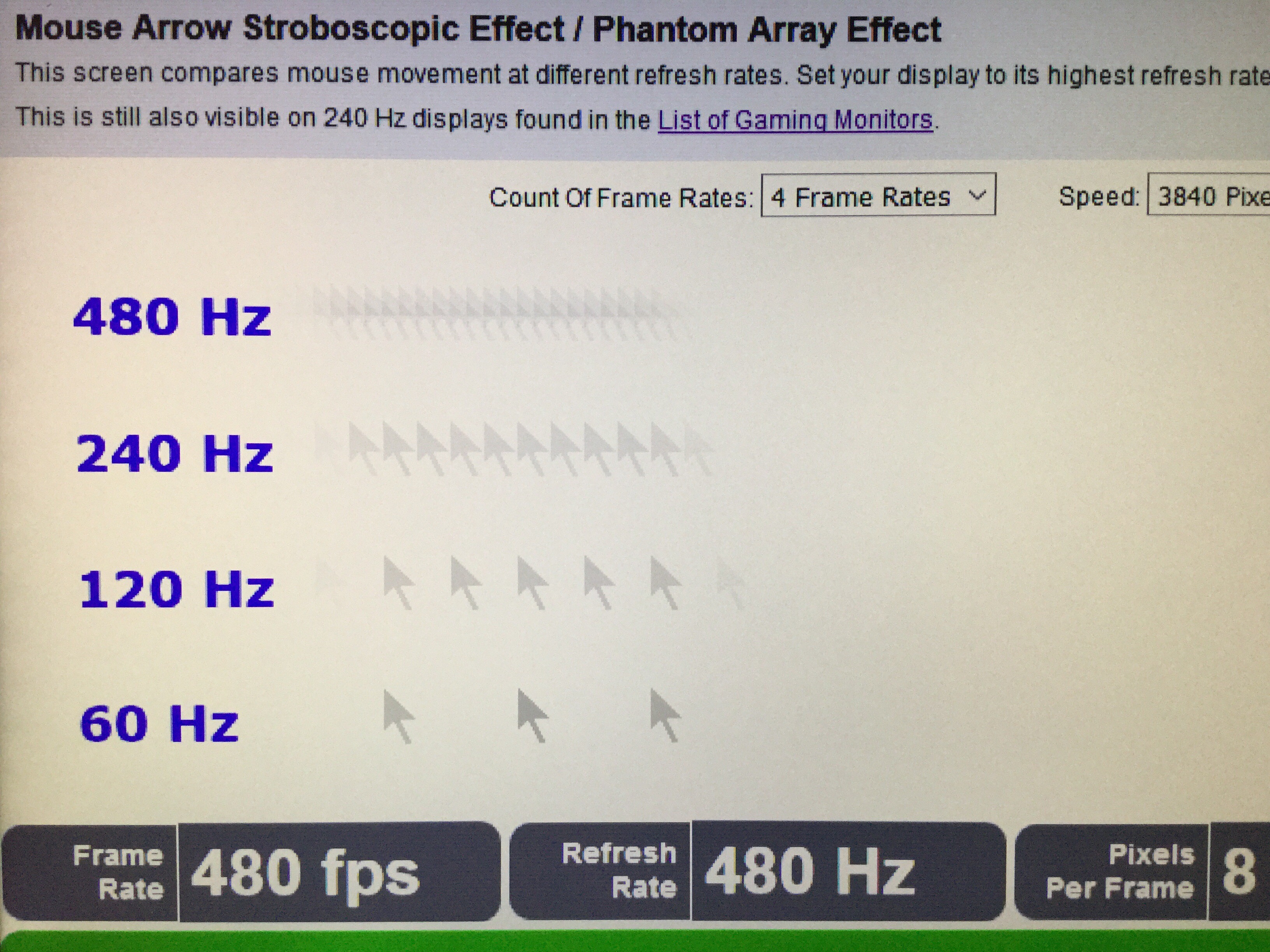
There are pros and cons to every monitor, but my experience with the Pulsar is that I genuinely can't go back to my OLED now – games in motion just look so much sharper and clearer.kyube wrote: ↑06 Feb 2026, 13:43The point is that these models don't have a clear-cut use-case they solve.brownvim wrote: ↑06 Feb 2026, 01:39I’m surprised about all the mixed takes on the monitor. Maybe it’s because of different use cases, not sure.
I have the pulsar, been gaming on it the past week (Black Myth Wukong from my backlog I’m trying to get through). I went back to my OLED and it looks horrible in motion now.
I should state the oled is only 175hz but this is a heavy game to run and that’s around the same frame rate I’m running it on the Pulsar. I find the OLED irritating/jarring/off putting to look at because of the blur now.
There are models which cost 1/4 the asking price of these models without their detriments (TMDS standard "HDMI 2.1" port, locked down PW adjustments in ULMB2 mode, DP1.4 only for Pulsar, Nvidia GPU vendor lock-in, added processing latency)
Fixed refresh rate strobing (Dyac1/+/2, ULMB 1, PureXP), when being limited by the game's frame rate for chasing eye-tracked motion performance, is a far better clarity target than variable refresh rate strobing (Pulsar).
Even the older single-strobe BenQ models (e.g.: XL2411P) or others listed here do a far better job for a “retro” (<100FPS) use-case. Even a CRT with an adapter is a much better option.
VSYNC exists for fixed refresh rate as well. SK's Latent-Sync exists. RTSS' Scanline-Sync exists.
700€ gets you a 610Hz TN (e.g.: AOC CS24A / AG246FK6) or +360Hz OLED (e.g.: Philips 27M2N8500), both of which come with HDMI 2.1. as of Q1 2026
250€ gets you a AOC Q25G4SR (24.5" QHD 300Hz KSF/PFS IPS LCD)
Clear cost cutting.
The Mediatek MT9810 (scaler IC) found in these Pulsar models is able to do HDMI 2.1 FRL6.
If they've launched it <500€ with HDMI 2.1 FRL6, I could somewhat understand it's appeal in today's market.
But now?
OLED exists within the same price range, making it's sample & hold performance irrelevant.
Better backlight strobing exists within the same price range, making it's impulsed performance irrelevant.
What use-case does it have?
I don't play many competitive FPS titles chasing 500+ FPS; I prefer single-player games where frame rates fluctuate a lot. That's why I'm not willing to lock FPS just to hit a "sweet spot" on older strobing tech.
Your suggestions all have trade-offs for my type of gaming:
A 500+ Hz OLED would still give me sample-and-hold blur across the wide range of frame rates I actually play at – I can't run everything at 500+ FPS just to make it "better" than Pulsar.
The 610 Hz TN panels are probably great for esports, but they're 1080p only, no true VRR strobing, poor colours/angles, and locking FPS is a hassle.
I had an FW900 CRT back in the day and loved it – amazing at 60 FPS for PC and Consoles – but it wasn't perfect (geometry/convergence/focus tweaks, 980 Ti limit, no VRR, limited inputs).
Other strobing monitors all have their sweet spots and nasty crosstalk outside them.
Let's see how Pulsar handles 48–110 Hz once the firmware is released – that's its main weak spot for me right now (sharp overall, but the faint double-image I can't stand). Could be brilliant for retro games too. I played Shinobi and it looked great.
I do wish it worked properly on consoles though, a PS5 Pro connected to it would be so good.
Bottom line: my use-case is effortless plug-and-play clarity on PC, especially with variable frame rates in single-player titles. Pulsar nails that for me. no monitor is perfect, maybe one day.