Re: Is There Still a Future for 240Hz+ IPS panels in 2026?
Posted: 01 Mar 2026, 07:59
I think we're aligned that overshoot, consistency, and curve shape all matter. However, my question is strictly about a fixed refresh rate, fixed FPS, and the best usable overdrive with no visible overshoot, for example in a competitive FPS like Overwatch running at constant 240 FPS, not in an application where I'll be switching between 240FPS games and low FPS games.Chief Blur Buster wrote: ↑28 Feb 2026, 14:58There are GtG curve shapes, and GtG heatmaps, where refresh rate compliance 100% looks worse than refresh rate compliance of 75%.
LCD GtG is often a curve that looks like this:
. . . .
In that situation, refresh rate compliance directly reflects whether the panel can physically complete pixel transitions within the 4.17 ms refresh window at 240 Hz, right?
If one panel achieves ~80% compliance, most transitions complete within the refresh interval, so pixels reach their intended value before the next frame, resulting in motion clarity "closer" to true 240 Hz behavior.
If another otherwise similar panel, still at fixed 240 Hz and optimal overdrive with no overshoot, only achieves ~30–40% compliance, then most transitions extend beyond the refresh interval. This means pixels are still transitioning when the next frame arrives, which should produce more trailing and reduced motion clarity.
So in this controlled scenario, is it correct to say that the panel with higher refresh rate compliance will objectively produce clearer motion, simply because more transitions complete within the refresh window?
For example, if one display achieves ~60% compliance and another only ~20%, with both having clean overdrive and no overshoot, the 60% panel would objectively deliver clearer motion, correct?
I understand that refresh rate compliance alone doesn’t tell the whole story, and that the full GtG heatmap and full OSRTT data are important to evaluate overall behavior. But at a fixed refresh rate, compliance still seems to be a direct indicator of how fully the refresh rate is physically utilized.
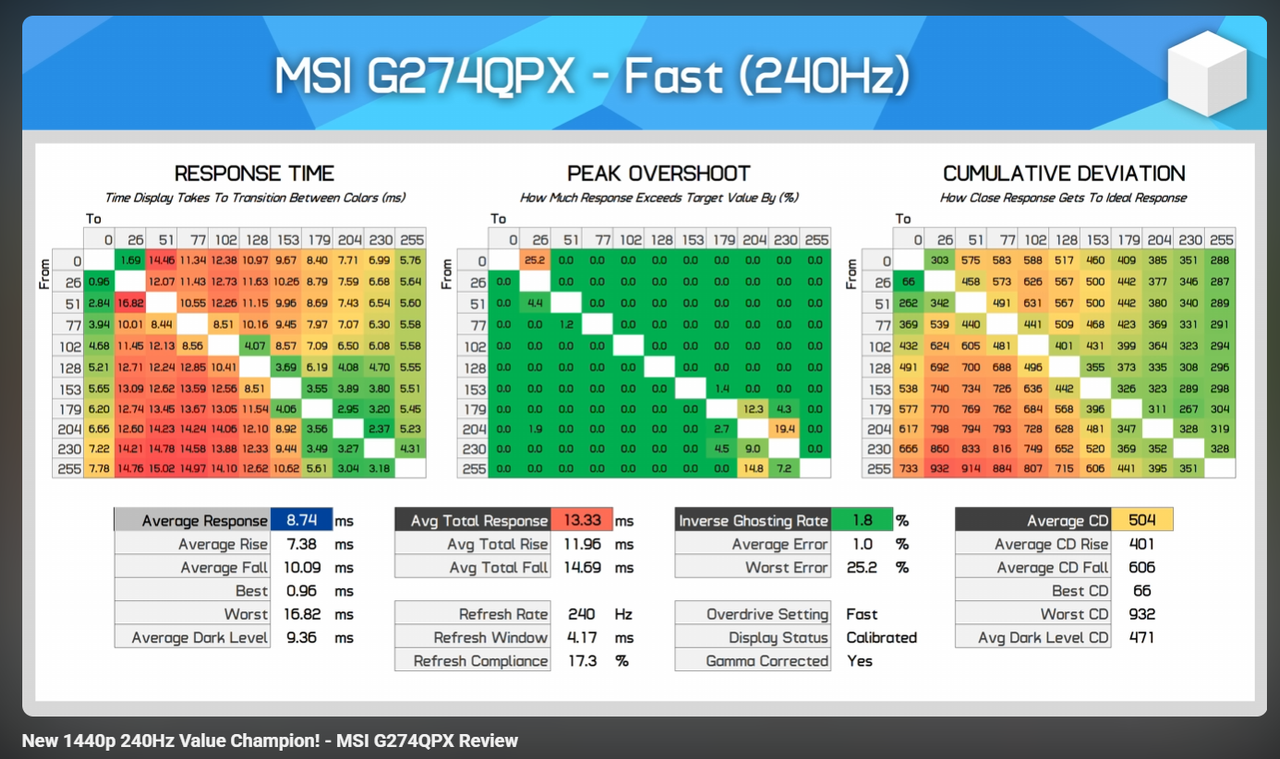
Let's look at the two screenshots below, it will help me understand better. We agree that this MSI is "bad" here, right? (I remind you, I'm talking about stable 240Hz/240fps use on a game like Overwatch.) Here, the OD Fast is the "best OD," because the next one, which is the last OD, has too much visible overshoot.
Here, the Zowie seems better, right? 50% R.R.C and "inverse ghosting rate" only at 1.8%, technically, in stable 240hz/240fps use, the Zowie is "better" if we base ourselves on this metric, right?
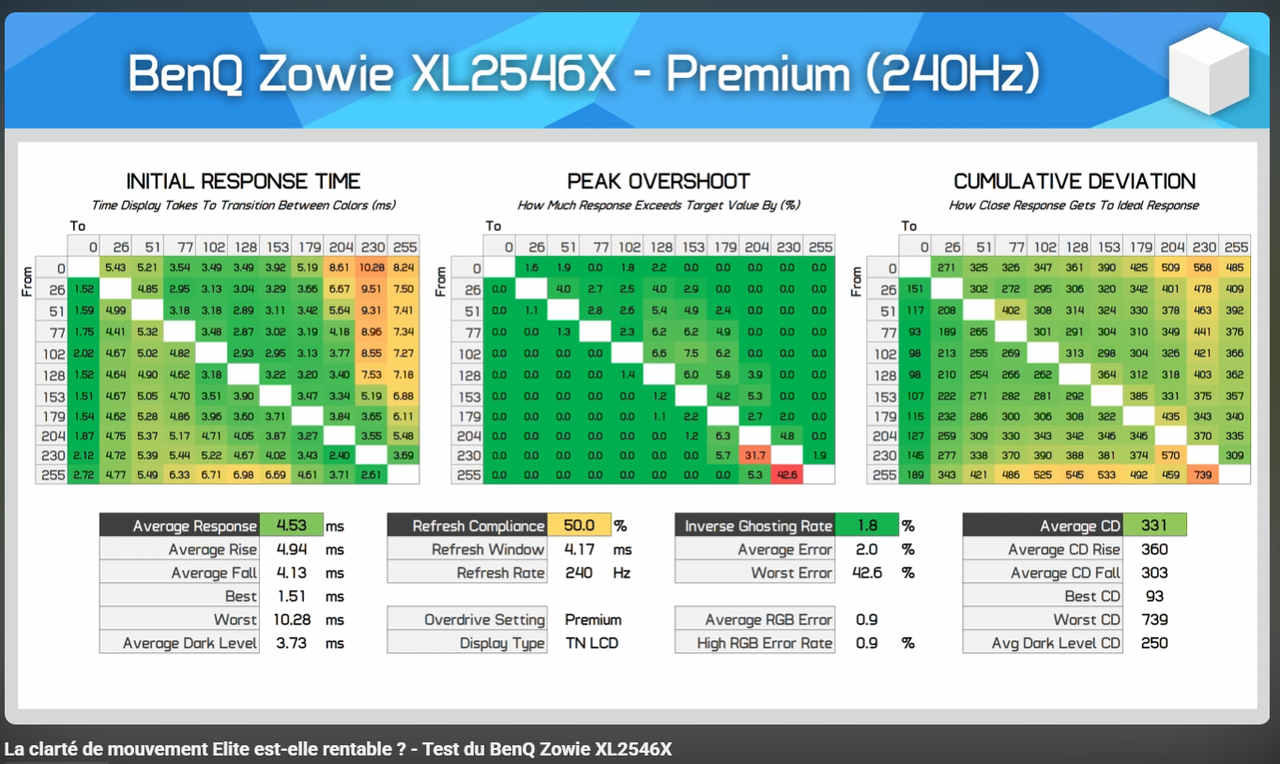
If my reasoning is still wrong and incorrect, please explain why using the two images above, and what exactly should we look at in these images to know if it's "good or not"?