witega wrote: ↑06 Dec 2019, 14:39
So Chief is PureXP set to "Ultra" the only option one has for CRT readibility with that Panning Map test?
The answer is murky because different CRTs have different phosphor decay speeds, and CRT phosphor is a sawtooth pulse graph (rapid rise, sharp peak, slow fall), while strobing is essentially square wave (rapid ride, flat top, rapid fall). All settings are much closer to CRT than default. The differences are very subtle and unnoticeable at slow panning speeds, and the differences between PureXP settings more easily reveal itself at fast panning speeds (like 1 screenwidth per second or faster).
witega wrote: ↑06 Dec 2019, 14:39
Does G-Sync, even with ultra low latency enabled, still has more blur?
VRR non-strobed produces display motion blur directly proportional to frametime, according to
Blur Busters Law
Here are two charts that will help explain things better:
For strobed, (including PureXP)
While this is slower motion speeds though (
960 pixels per second standardization), and doesn't include <1ms, but it does help demonstrate some concepts. Double the motion speed, you double the blur trail length, and then it becomes easier to see differences at lower persistence at faster motion speeds.
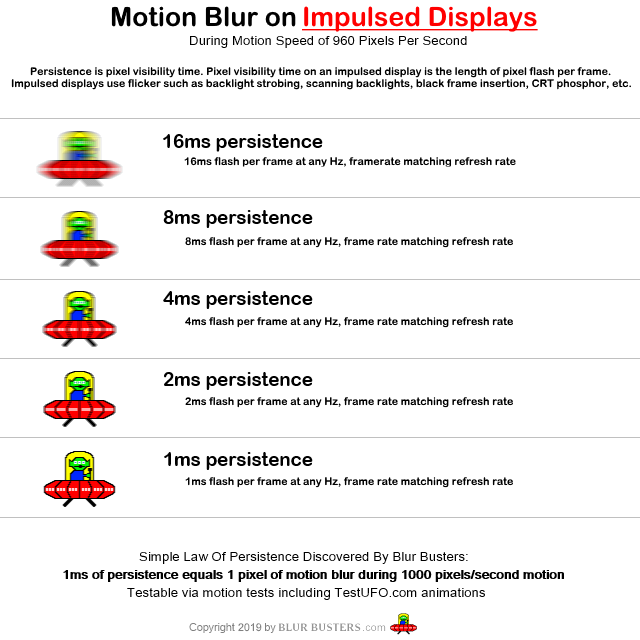 For non-strobed (including variable refresh)
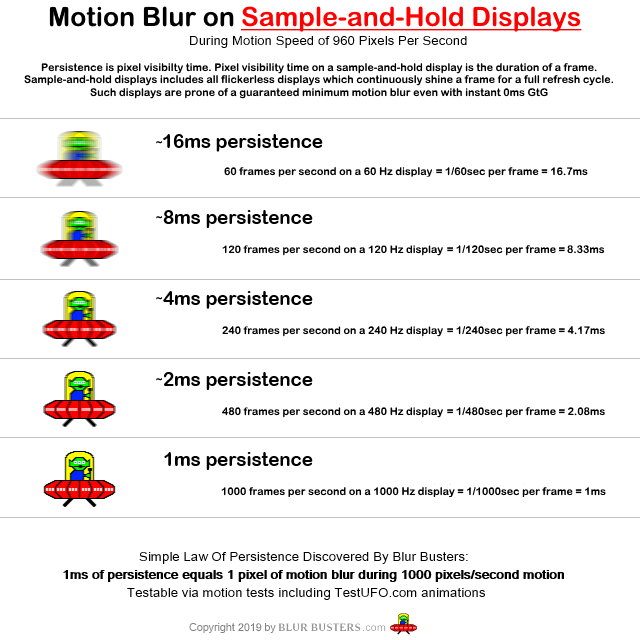
Since 240Hz is the maximum Hz, you are bottlenecked to no less than 1/240sec = ~4ms persistence for non-strobed VRR.
That does not include GtG, which can produce additional motion blur above-and-beyond Blur Busters Law of 1ms = 1 pixel blur per 1000pix/sec motion.
For PureXP (new firmware), the PureXP="Light" setting is roughly ~2.8ms persistence at 144Hz, while PureXP="Ultra" is closer to ~0.7ms persistence at 144Hz. This technically falls to ~1.7ms persistence at 240Hz for PureXP="Light", and ~0.4ms persistence for PureXP="Ultra" (That's at the PWM switching level. Real life measurements will vary a bit from this, since white backlight LEDs have phosphor, and there's a very tiny sub-millisecond phosphor decay associated with that) but that doesn't account for strobe crosstalk which can begin to interfere with MPRT/persistence measurements once crosstalk raises above 10%.
Roughly, the pulse lengths of PureXP in the latest firmware:
Light = 4/10th refresh cycle strobe length
Normal = 3/10th refresh cycle strobe length
Extreme = 2/10th refresh cycle strobe length
Ultra = 1/10th refresh cycle strobe length
Right now, current monitors are shipping using an ON setting close to "Ultra" setting by default . So it's like OFF/Ultra in the first firmware, while the new firmware are OFF/Ultra/Extreme/Normal/Light. So you're getting brighter settings with just a smidgen more blurring.
