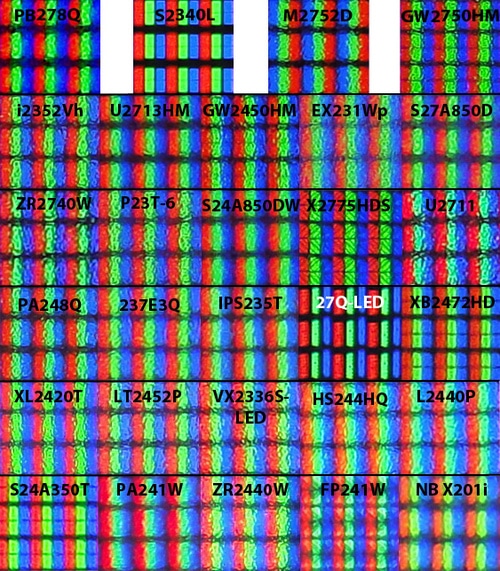
flood wrote:About the beads thing, what I mean is that you could take a 32k display and you'd still be able to see beads from 10 ft away when the angle is shallow enough. That doesnt mean that 32k displays is noticeably better than 4k displays at 10ft. Why? because it's possible to draw an image on the 4k display that, at 10ft, looks indistinguishable from the beads on the 32k display (you would make such an image by downscaling the beads in a gamma-aware program).
It's true that you can fix the gamma in the aliasing. But even without the aliasing, you also have other unexpected factors.
There are actually a surprising array of effects that prevent, for example a theoretical "holodeck turning test" -- "
Wow, I didn't know I was standing in Holodeck" (real life versus Holodeck). If we ever get that far to come to the point of being able to do such a Holodeck Turning Test, 4K resolution at 10 feet still isn't going to cut it for many reasons:
-- Moire artifact effects (nyquist, etc). You can filter/soften to prevent/reduce this, but at some point, the filtering/softening becomes noticeable as "why is that surface solid rather than textured". It's very subtle, a close companion is looking through a real-life patio screendoor from about 15-20 feet away; sometimes textured things that moves behind it seems to 'shimmer' even though we can't see the screendoor itself. To eliminate sampling tradeoff (shimmering vs softness) with fine patterns (high contrast fine-striped and high contrast fine-patterned textures, like thin-striped shirts), you practically need to double the resolution so you can add necessary softening, and the softening would still be below human perception thresholds.
-- Superresoluion effects. Slowly moving fine-stuff (e.g. brightly sun-lit newspaper page viewed at a far distance) looks different on a 4K at 10feet, than in real-life at 10 feet. You either have to keep it sharp (and create shimmering/aliasing effects) or softened (and potentially create noticeable softness). Up the resolution or increase distance compensate so you don't have to do the "pick your poison" either-or effect. Dislay pixels is a grid and human eye photoreceptors is a more random scatter, so you get different superresolution behaviors. Here, the object is not "Can you see the pixel", but becomes "does the motion look different virtually than in real life"?
-- Star twinkle effect. The same reason why planets look different from stars, even though both 'points of light' are tinier than human resolving power.
-- Display technology limitations such as asymmetric speed of pixel transitions (e.g. from black to white, and white to black) which changes gamma behaviour depending on direction of movement (white moving into black, versus black moving into white). This has been a problem for LCD, which hopefully gets solved when OLED eventually arrive in large quantities (e.g. high expense, difficulty of manufacture,
motion blur, etc).
-- There's still lots of side effect of snapping to a pixel grid, while eyes' photoreceptors are distributed more randomly, and we have to compensate (e.g. filtering, which then introduces effects at a coarser level).
To eliminate all the above effects simultaneously, you need about a x2 factor of the human's maximum resoloving power. That way, macro effects (2x2 pixels) still is smaller than human resolving power. And then you need to simultaneously aim at the small percentile that has better than average vision, etc.
For most, nobody may notice. But what if we want to make a huge target percentage (e.g. 99.9%) of human population happy, including the ones with better vision acuity in certain areas. So if good quality 4K costs only $50 more than good quality 1080p, then why not? 1080p has finally replaced 720p in the cost picture...
Another major problem for "maxing out 4K" is the source side of things. Look at the bayer cameras, for example! The cheaper 4K cameras don't max out all the color channel's maximum resolution. So even when displayed at an average of 3 subpixels per physical pixel, you may only be getting content of less than that, due to the original bayer-based source. Content from Sony's 8K camera (6K actual, bayer) look much sharper broadcast at 4K. Likewise, 4K downconversions to 1080p often look better than native 1080p cameras broadcasting 1080p.
Certainly, this doesn't matter for peripheral vision, though. Theoretically, a more efficient use of resolution is to use extreme resolution in the center of where the human vision is pointing at, and less resolution in peripheral vision. At this point, 4K would be vastly more than enough. But resolution-adaptive spatially-varying-resolution eye-tracking displays are probably not practical, and even less so, for multiple humans staring at the same display.
More scientific vision research certainly needs to be done on this topic!
(Hmmm. This discussion is venturing into Area 51 league!)