Page 1 of 1
Best OLEDs and QD-OLEDs with no PWM?
Posted: 04 Jul 2023, 10:05
by life_at_1ms
I'm looking for a desktop display for video editing, reading text, and low latency gaming (not the highest priority, but nothing competes with OLED for overall latency, so I'm still trying to find an OLED). I also hear temporal dithering is used in some, which also causes eye fatigue. So, what are the best 27 - 32 inch non-curved OLEDs that will have the lowest possible eye fatigue? Another reason I want no PWM is because at night it is nice having the display at a lower brightness, which is a no-go with PWM. And yet another reason why PWM is nonsense is because some manufacturers (like in ASUS laptops) is that in order to control the PWM properly, ASUS' windows-only software is required.
Thanks Blurbusters!
Re: Best OLEDs and QD-OLEDs with no PWM?
Posted: 04 Jul 2023, 16:51
by Chief Blur Buster
There is some kind of a faint once-per-refresh-cycle partial brightness dip on most OLEDs -- but if you can't see these at 100% brightness on an iPhone or Galaxy or OLED TV, then you won't have problem with the new 240Hz OLED displays even at minimum brightness, as they don't use PWM-based dimming. (The tiny sub-millisecond dip once per refresh is due to a refresh logic)
I suggest giving one of the new 240Hz 27" 1440p WOLED displays a try! Very eye pleasing.
Re: Best OLEDs and QD-OLEDs with no PWM?
Posted: 05 Jul 2023, 21:19
by life_at_1ms
I'm not finding any panels listed as WOLED with listed as 240Hz 27" - have a model in mind specifically?
Thanks.
Re: Best OLEDs and QD-OLEDs with no PWM?
Posted: 05 Jul 2023, 23:40
by Chief Blur Buster
Please refer to this chart:
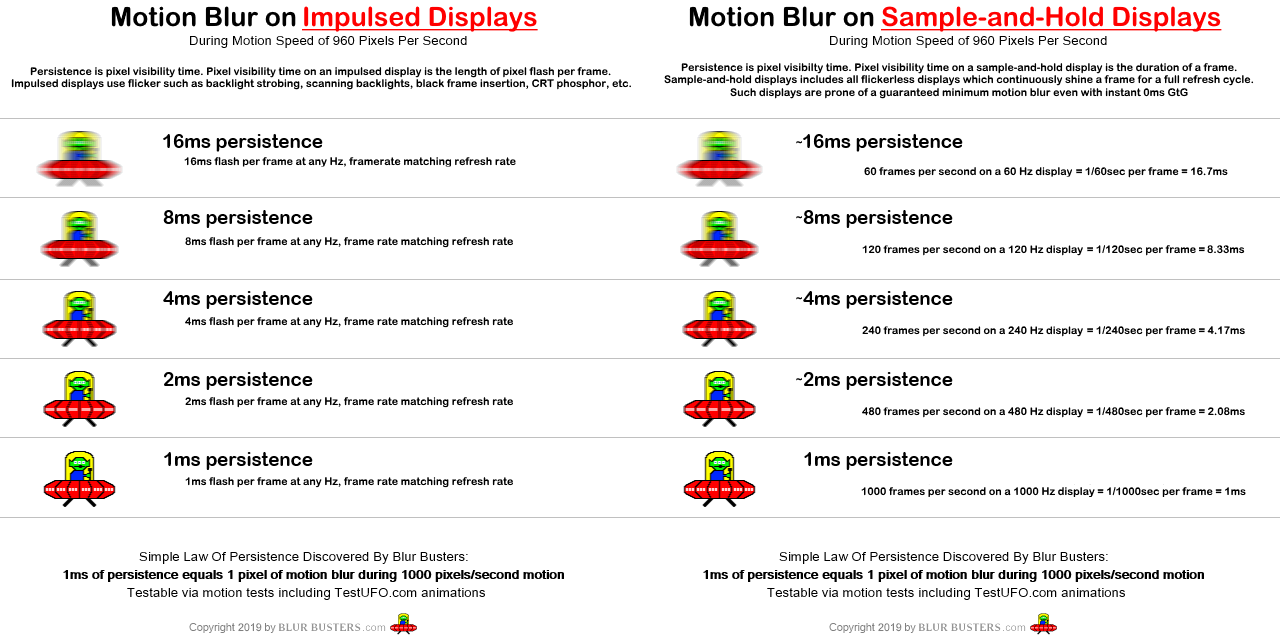
Today, LCD strobing is 1ms, and direct-view OLED BFI can't yet go far below ~4ms.
VR-based OLED BFI can get pretty low (~2ms at lower brightnesses), but direct-view OLED BFI is blurrier.
XG2431 can do under 0.25ms with PureXP Custom but very dim, and Oculus Quest 2 can go as low as 0.3ms.
PureXP Custom via Strobe Utility is adjustable in persistence from 1% refresh cycle (1% brightness of max-brightness nonstrobed) to 40% refresh cycle (40% brightness of max-brightness nonstrobed).
Brute framerate based motion blur reduction (1000fps 1000Hz) is vastly superior to BFI and strobing, but we don't have 1000Hz OLEDs yet... (2027-2030ish), and we need lagless frame generation to achieve that --
www.blurbusters.com/framegen
The choice depends on your priorities. OLED has many pros/cons, and you have to prioritize whether you prefer 1ms LCD MPRT (with the LCD disadvantages), or 4ms OLED MPRT (either via brute method 240fps 240Hz, or via 4ms BFI pulsing of lower frame rates).
OLED BFI (for 120Hz and less only) is indeed coming to certain 240Hz OLEDs. Keep tuned.
See thread:
List of 240Hz OLEDs if you're choosing a 240Hz OLED.
Re: Best OLEDs and QD-OLEDs with no PWM?
Posted: 10 Jul 2023, 14:40
by tong
Chief Blur Buster wrote: ↑05 Jul 2023, 23:40
Today, LCD strobing is 1ms, and direct-view OLED BFI can't yet go far below ~4ms.
What is the technical reason for OLEDs not being able to go below 4ms? Too dim or flickery?
OLED could be the perfect display for BFI implementation due to no crosstalk and near-instant response times.
Re: Best OLEDs and QD-OLEDs with no PWM?
Posted: 10 Jul 2023, 16:11
by jorimt
tong wrote: ↑10 Jul 2023, 14:40
What is the technical reason for OLEDs not being able to go below 4ms? Too dim or flickery?
OLED could be the perfect display for BFI implementation due to no crosstalk and near-instant response times.
Primary reason is sustained full-field brightness can't quite get high enough right now on OLED (typically ~250 nits max) to counter brightness reduction of lower pulse width strobing, which is part of what is needed to achieve sub 3ms MPRT on OLED without too much dimming or flicker.
Re: Best OLEDs and QD-OLEDs with no PWM?
Posted: 11 Jul 2023, 01:35
by life_at_1ms
But the lower latency of the OLED needs to be factored into that:
https://www.youtube.com/watch?v=Oy3cKwq ... ture=share
So if we consider the whole system (hand to eye), then OLED is giving you an edge that isn't closed by any LCD - isn't it?
Re: Best OLEDs and QD-OLEDs with no PWM?
Posted: 11 Jul 2023, 15:45
by Chief Blur Buster
If the picture is only 25 or 50 nits compared to a 300-nit BenQ DyAc, you aren't going to react fast to photons you can't see.
There's a compromise and sweet-spot effect involved, so you need higher MPRTs with OLEDs. However, OLEDs do produce higher-quality MPRTs (for same numbers than LCD can do). The 2ms Oculus Rift OLED looked much better than 2ms LightBoost strobing, for example. So there's a biasing-upwards factor due to all other quality attributes.
However, getting to 0.5ms-1ms MPRT's that strobed LCDs can easily do, is still going to be a difficult call for OLEDs.
At this stage, it's now becoming easier to engineer a 1000fps 1000Hz OLED and eliminate motion blur strobelessly (
via lagless frame generation) for modern PC content, and have none of the brightness loss. 480Hz OLEDs are now roadmapped in a few years, and 1000Hz OLEDs are "before the end of this decade" stuff now.
When I can push frame rates high enough -- For certain content I actually now have a personal preference to the 4ms MPRT of 240fps 240Hz OLED strobeless, over roughly 1-2ms MPRT of strobing. Strobing creates some stroboscopic artifacts too (see
The Stroboscopic Effect of Finite Frame Rates, so avoiding the strobing reduces the stroboscopic artifacts a bit). Now that being said, once OLED hits 8ms MPRT, I start to prefer 1ms MPRT LCD strobing.
Even 4ms MPRT strobeless versus 1ms MPRT strobed -- is already becoming a preference sweet spot for some people for some content (e.g. playing the new System Shock remake, which is wonderful on OLEDs).
I still prefer strobing for retro content (e.g. fast-motion 60fps and 120fps content)
I want my cake and eat it too though! 1000fps 1000Hz 1ms MPRT on OLED or other "near 0ms GtG" technology. New article about
lagless frame generation.