✅ [Chief Blur Buster - ACCURATE] The human eye can see 39,620 Hz ✅
Posted: 10 Feb 2026, 09:15
Who you gonna call? The Blur Busters! For Everything Better Than 60Hz™
https://forums.blurbusters.com/
Pesky GtG throttle on Hz differences. Higher Hz will require GtG getting closer to 0.00000Chief Blur Buster wrote: Retina refresh rate is extremely high! 5-digit Hz.
Kudos to techless for fantastic video (39,620 Hz, though estimated ~20,000 Hz a few years ago).
There are 4 main visibility thresholds. Expand this tweet/post to dive into rabbit hole for a momentִֶָ
Approximate orders of magnitude for framerate=Hz:
- 10 = slideshows turns into motion;
- 100 = flicker ceases to be visible (Talbot Plateau)
- 1000 = (at GtG=0.0) motion blur ceases to be visible for tiny 1080p screens
- 10000 = motion blur and stroboscopics cease to be visible for wide-FOV retina resolution screens.
This is assuming you zero out all 1000+ hardware & software weak links. Tiny list of examples: no jitter, no stutter, no GtG. GtG makes 500Hz OLED have clearer motion than 1000Hz LCD: You don't want 1ms GtG before/after your 1ms frametimes.
Now, let's go extreme, for the 5-digit number.
Let's imagine a giant 2000Hz 8K TV on your desktop. It's a sample-and-hold display at retina resolution, so no flicker-based motion blur reduction. You have a 90-degree FOV of that TV on your desk.
It's retina resolution for static images, but motion blur puts pixels below retina resolution. Panning motion at 8000 pixels per second, one screen width per second. Still easy to eye-track.
For framerate=Hz:
- 2000 Hz, 8000pps = 4 pixel motion blur
- 4000 Hz, 8000pps = 2 pixel motion blur
- 8000 Hz, 8000pps = 1 pixel motion blur
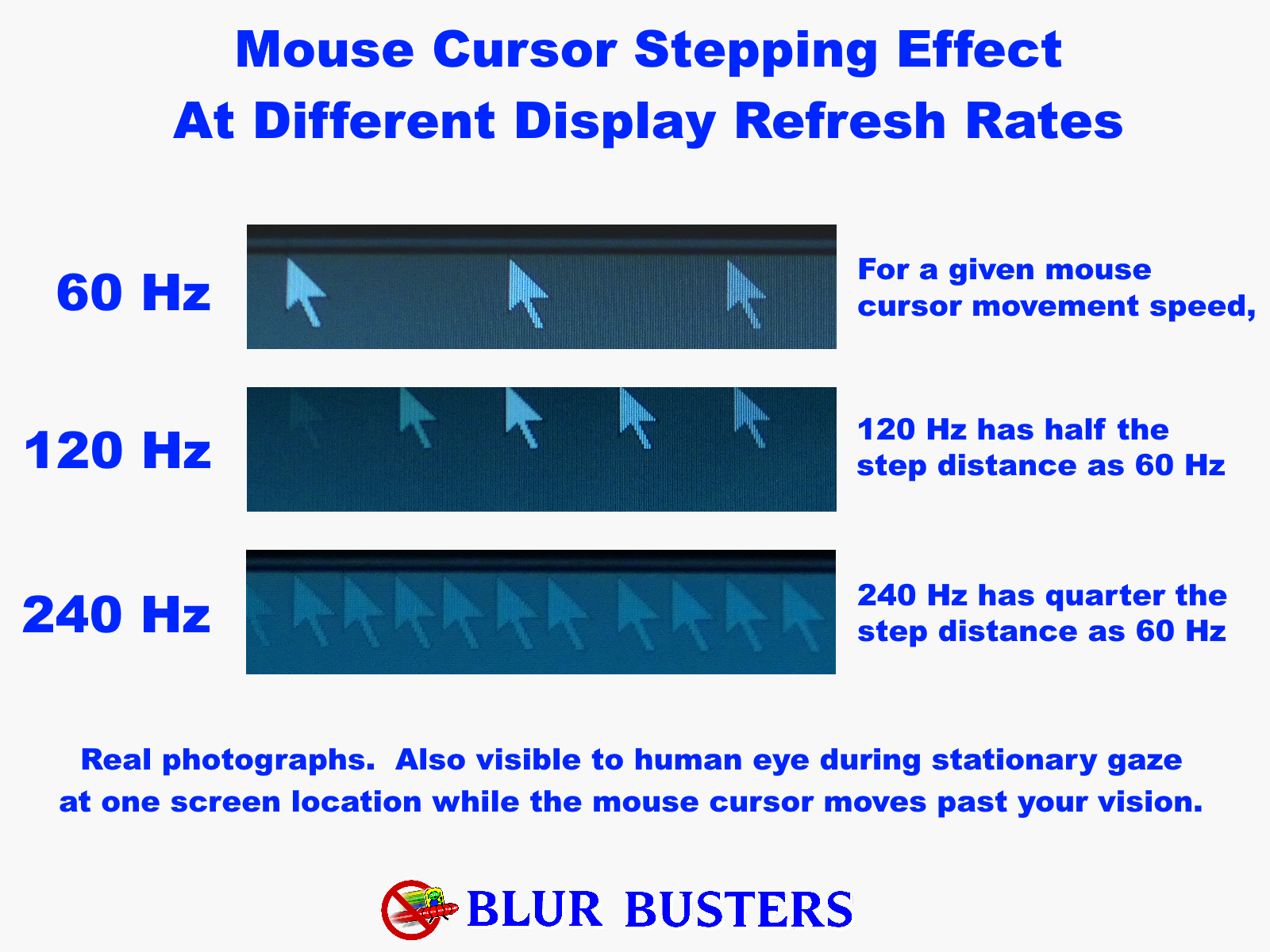
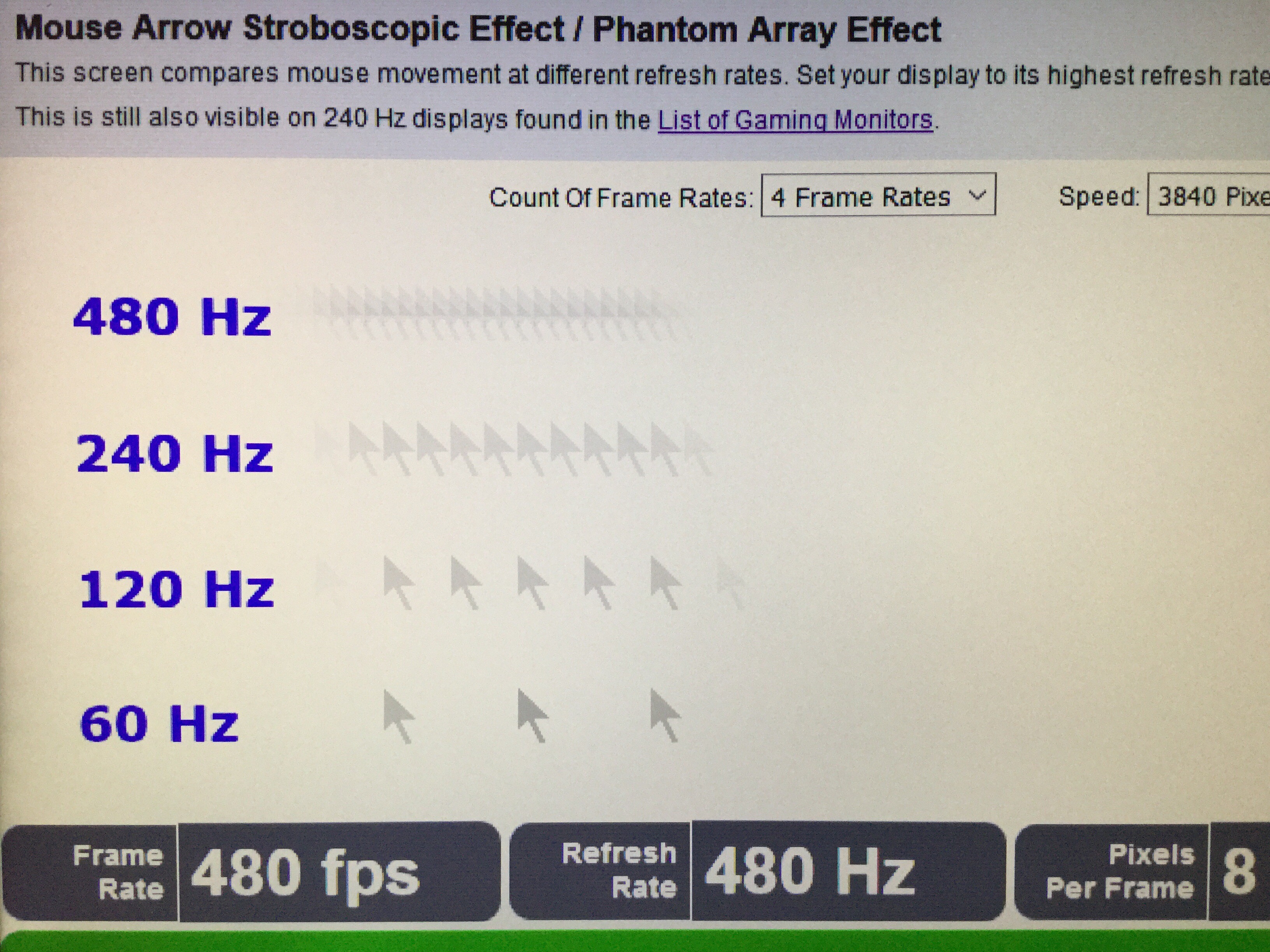
That's for eye tracked gazes. For fixed gaze, that's stroboscopic effects (phantom array) at that pixel step. So to fix that, we can add GPU motion blur to fix that. That doubles retina Hz.
Add GPU motion blur to fix stroboscopics:
- 2000 Hz, 8000pps = 8 pixel motion blur
- 4000 Hz, 8000pps = 4 pixel motion blur
- 8000 Hz, 8000pps = 2 pixel motion blur
- 16000 Hz, 8000pps = 1 pixel motion blur
And that's for a 90-degree FOV desktop 8K display. Move to a 16K 180-degree VR display with even faster motionspeeds, and you start getting numbers much closer to 40,000 fps=Hz like the techless video.
So techless nailed the ballpark retina Hz for a strobeless sample-and-hold display. A display where you want to simultaneously eliminate both motion blur AND stroboscopics AND flicker.
Obviously, our work is cut in front of us, to fix 100 layers of the "weak links onion" of many system and hardware stutters/blurs. It's why motion on 500Hz OLEDs currently outperform 1000 Hz LCD.
Blur Busters Law dictates:
- Motion blur = pulsetime for strobing
- Motion blur = frametime for sample & hold
Strobing is a fantastic solution for lower frame rates (Hello DyAc and BFI and GSYNC Pulsar and XG2431) but not everyone can handle it, too many of us get eyestrain.
TL;DR: Lots of display progress still coming. We currently predict 2000 Hz consumer displays arriving by 2030, and 4000 Hz consumer displays arriving by 2035.
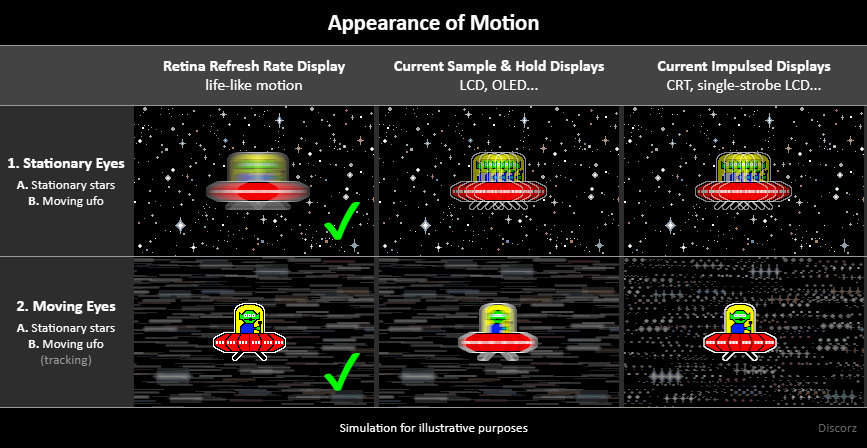
(Image: Comparision from content creator in China, merged into one image by Discorz)

 ִֶָ
ִֶָ