owlo11 wrote: ↑Yesterday, 12:24
I prefer heavier, weightier movement and controls, and I find them more immersive. Given my preference, which of the two do you think I would find more immersive?
"Immersive" is somewhat of a ambiguous, high-level term, which doesn't help one give you a definitive answer.
We need to be a bit more rigorous in definition IMO.
Those 2 scenarios you've given cannot "look the same" because we're talking about 2 different rates of change (different service & arrival rate) with a ton of ambiguity of other parameters.
(TLDR is below, if you don't care about rant)
Generally, when discussing these topics, It's good to classify them something along these lines or as follows:
Level 0 – Fundamental System Parameters
a) Source frame presentation (frametime distribution AKA pacing)
b) Display scanout (encompasses refreshtime & scanout time; where tref = tscan + tblank)
c) Pixel response (ignored if assuming OLED)
d) Emission / persistence / backlight operation mode (impulsed/strobed or sample & hold)
e) Spatial resolution (source/image/frame resolution & display resolution)
f) Physical distance to screen (impacts FoV)
Level 1 – User / Engine Control Mechanisms
a) Frame rate control AKA limiters (which we'd further categorize depending on:
aa) Timing / synchronization / waiting mechanism (sleep & time waits, synchro-object waits)
ab)
Pipeline insertion point (simulation, render, present)
ac)
Timing clock sources (HW sources such as TSC using RDTSC, SW-based ones such as QPC & others)
b) GPU-Display Synchronization Methods (none, fixed vsync, VRR)
Level 2 – Perceptual display properties
a) Perceived smoothness
b) Eye-tracked motion clarity AKA effective motion clarity (Nvidia term)
c) Perceived responsiveness
d) Spatial clarity
Level 3 – Temporal, Spatial & Spatiotemporal Phenomena
Level 3.1 – Temporal Phenomena
a) Constant Cadence
b) Periodic Cadence (perceptual consequence of this is
juddering)
c) Quasi-periodic Cadence (may or may not be visible, depending on severity)
d) Aperiodic Cadence (perceptual consequence of this is stochastic / workload-dependent stutter; which we'd further classify into macrostuttering & microstuttering, where you'd find issues such as shader compilation hitch, OS-related stalls etc.)
Level 3.2 – Spatial Phenomena
a) Spatial sampling artifacts (aliasing, moire, shimmering, crawling
b) Reconstruction / filtering artifacts (blur, ringing, oversharpening)
c) Geometric / rasterization artifacts (stair-stepping, polygon edge artifacts, texture aliasing)
d) Resolution-related artifacts (Upscaling & Downscaling)
Level 3.3 – Spatiotemporal Phenomena
...
(DLSS & other effects)
Level 4 – Experience
Immersion
Note: Please don't use this as a formal & rigorous classification of the digital system (GPU-monitor) chain. This is what I've thought of / devised of at the time of writing and can contain inaccuracies and badly / improperly worded sections.
In your 30FPS @ 120Hz (Scenario A) vs 30FPS @ 30FPS (Scenario B), when discussing it from the lens of aforementioned parameters, you'd have:
Scenario A:
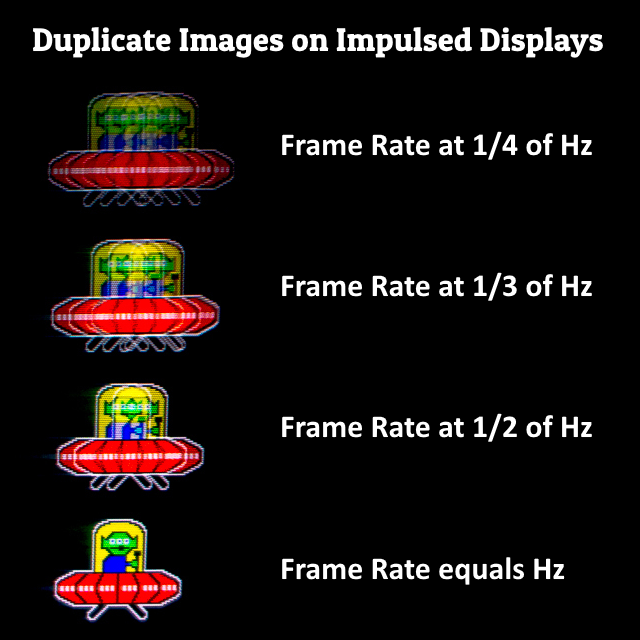
If emission / persistence / backlight operation mode is IMPULSED:
If GPU-Monitor synchronization method is NONE:
Tearing → Yes
Judder → No
Sample rate → Low
Eye-tracked motion clarity? "Good", if impulse technique is well implemented, but youre experiencing
aliasing-like effect, hence the quotation marks
If emission / persistence / backlight operation mode is SAMPLE & HOLD (STATIC BACKLIGHT):
If GPU-Monitor synchronization method is NONE:
Tearing → Yes.
Judder → No.
Sample rate → Too low to be close to emulate analog reality.
Eye-tracked motion clarity? Bad, as you're experiencing 30FPS/Hz blur AKA a low temporal image/frame resolution.
Scenario B:
If emission / persistence / backlight operation mode is SAMPLE & HOLD (STATIC BACKLIGHT):
If GPU-Monitor synchronization method is NONE:
Tearing? "Yes" (it's likely going to be moving, highly depends on frame rate limiter)
Judder? No. (assuming frame pacing is good.)
Sample rate? The same as above, low.
Eye tracked motion clarity? Bad, as above.
TLDR:
It's very difficult to say what's objectively "immersive". Even based on your subjective preferences, I'd have a difficult time to give you a more concrete answer.
Personally speaking, 30FPS cannot be immersive in the slightest from a temporal aspect.
Generally speaking, 120Hz with VRR+VSYNC+Reflex to whatever frame rate you're targetting is the usually correct answer.
Hope this helps...