KKNDT wrote:I was adjusting the VT to 2000+ and running at 120HZ while turning on strobe mode on my XL2540 to eliminate strobe crosstalk.
To my understanding, if I set VT to such high level, I may lose almost half of the frameslices/information with VSYNC OFF?
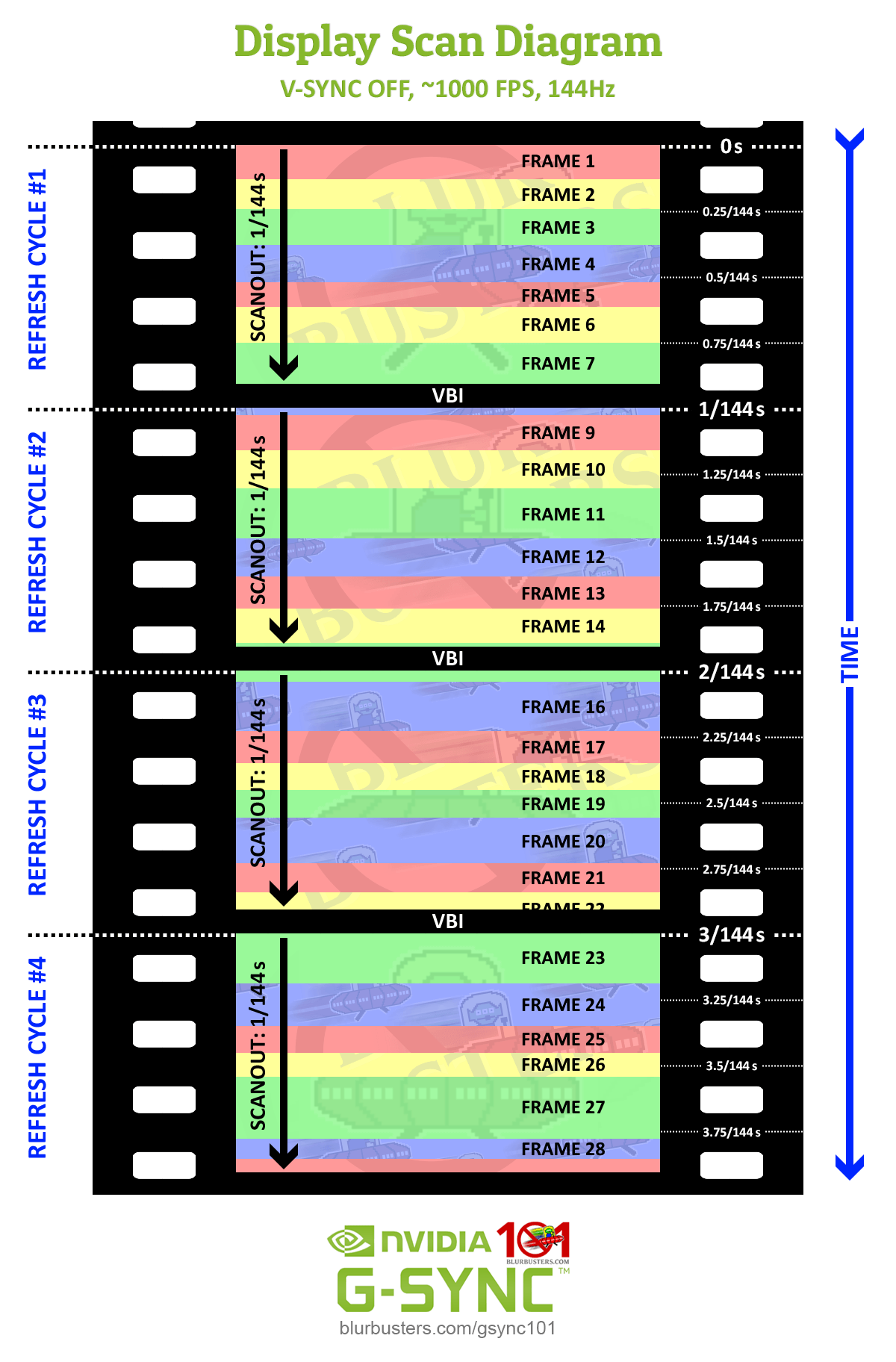
Only if ultra-high framerates such as 1000fps, only for super-huge blanking intervals (VBI's as big as the active picture -- e.g. VT2000 for 1080p). Most of the time, the frameslices will overlap to the top edge or bottom edge, not fully fit inside the VBI.
But this is more than offset by lag reductions of strobing & motion clarity improvements of strobing. You also have less lag-graident effect due to less lag differential between panel scanout (in dark) and panel visibility (flash). Basically, less lag differences between the top edge and bottom edge during VSYNC OFF strobed operation. So the benefical effects does cancel-out the bad effects.
The grand total of information is the same (same number of pixels seen per second) because the important frameslices (near crosshairs) become bigger to compensate for those missing frame slices. That's because of the higher pixel clocks that Large Vertical Totals, so the vertical spacing between tearlines is bigger for the same frame rate at the same refresh rate, when using Large Vertical Totals with that refresh rates.
You're getting bigger-surface-area reduced-lag frameslices onscreen (at no additional latency cost) to compensate for those missing offscreen frameslices. You've got faster scanout during Large Vertical Total mode, so you get more pixels per frameslice for a given frametime and framerate. That compensates hugely for the missing frameslices hidden by VBI.
In other words, due to the higher pixel clock of large VT's, the screen displays MORE information from the now-bigger onscreen frame slices to compensate for the missing frame slices. So at the end of the day, you're seeing the same amount of information in a counter-balanced way. Same resolution at the same refresh rate, you're just seeing a different number pixels from each frame slices, but the mathematical total number of pixels seen per second is the same (for the same refresh rate).
Same grand total amount of information -- you're getting new information from larger visible low-lag frameslices, that cancels out the lost information from the other frame slices. In other words, you're getting an equal amount of information, on average.
You're still only getting refresh-rate granularity updates for a specific given pixel, regardless of sync mode, so the missing frameslices tend to have no effect on the majority of gaming (on average). That frameslice closest to focus (e.g. crosshairs) is certainly the most important frameslice, and you'll be glad to know you've gotten a bigger frameslices (at no extra latency cost!) that overlaps the crosshairs, and any visible parts of screen, to make up for that lost frame slice hidden offscreen.
For a 144 Hz 1080p gaming monitor -- mathematically it's (1920x1080) x (144) = you're seeing 144Hz worth of 1920x1080 resolution, no matter what Vertical Total you use and how the frameslices essentially jigsaw-puzzle together, and the panel scanout latency of a frameslices is (1/framerate) second latency differential between top edge and bottom edge of a frameslice. So a bigger frameslice at the same framerate (e.g. 1000fps VSYNC OFF), without extra latency, nor latency gradients, is a bonus at where you're staring onscreen (e.g. say, a ball, a crosshairs, an enemy, etc) fully compensating for the missing frameslices that's far away from your screen focus anyway (action occuring just below bottom of screen, or action occuring just above top edge of screen anyway). So -- do you understand how things generally cancel out now?
Also, if you're using strobed operation, you're accepting strobed lag already (
Sometimes strobed has competitive advantages outweigh strobed lag, for certain kinds of game tactics), which is a bigger factor than the stuff in this thread...
In real-world practical applications, this is a molehill thread compared to the mountain that is the strobe-lag discussion. Overall Lag tends to be the a bigger eSports question.
(This topic matter is indeed a good scientific question though, of curiousity -- but...)