gusta456 wrote:THANKS Chief for this informaiton, and I would like to know if your settings are persistent and crosstalk and the companions in general are co-competitive and if they are well configured and if there is something that I can change in your opnion ? <3

Adjust to
preference.
Strobe Utility tends to be massively more effective on the 1080p 144Hz BenQ ZOWIE displays (bigger improvement to strobe quality).
Right now, we're nitpicking over mere milliseconds. Your affect this is only +/- 2ms (the midpoint of a 1/240sec refresh cycle) so it won't really matter in the majority of cases. However, for further reading:
<Advanced Information>
The latency differences you'll do is mainly latency-gradient related:
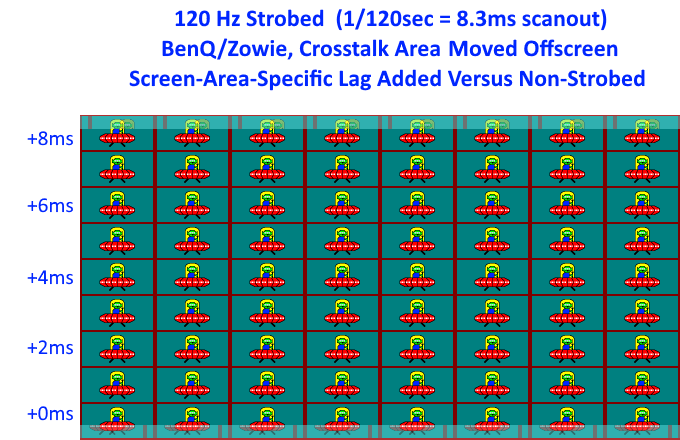
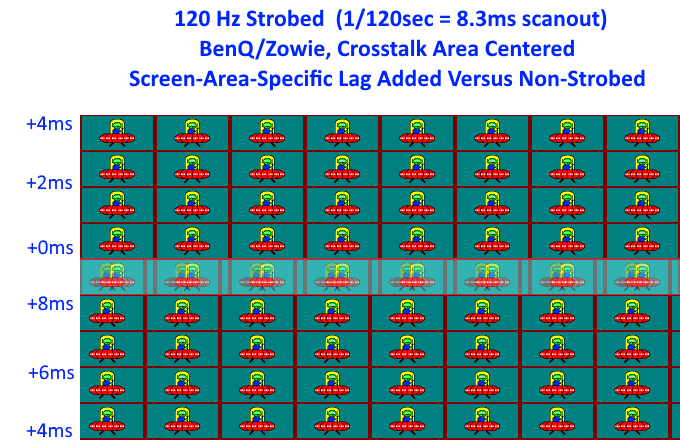
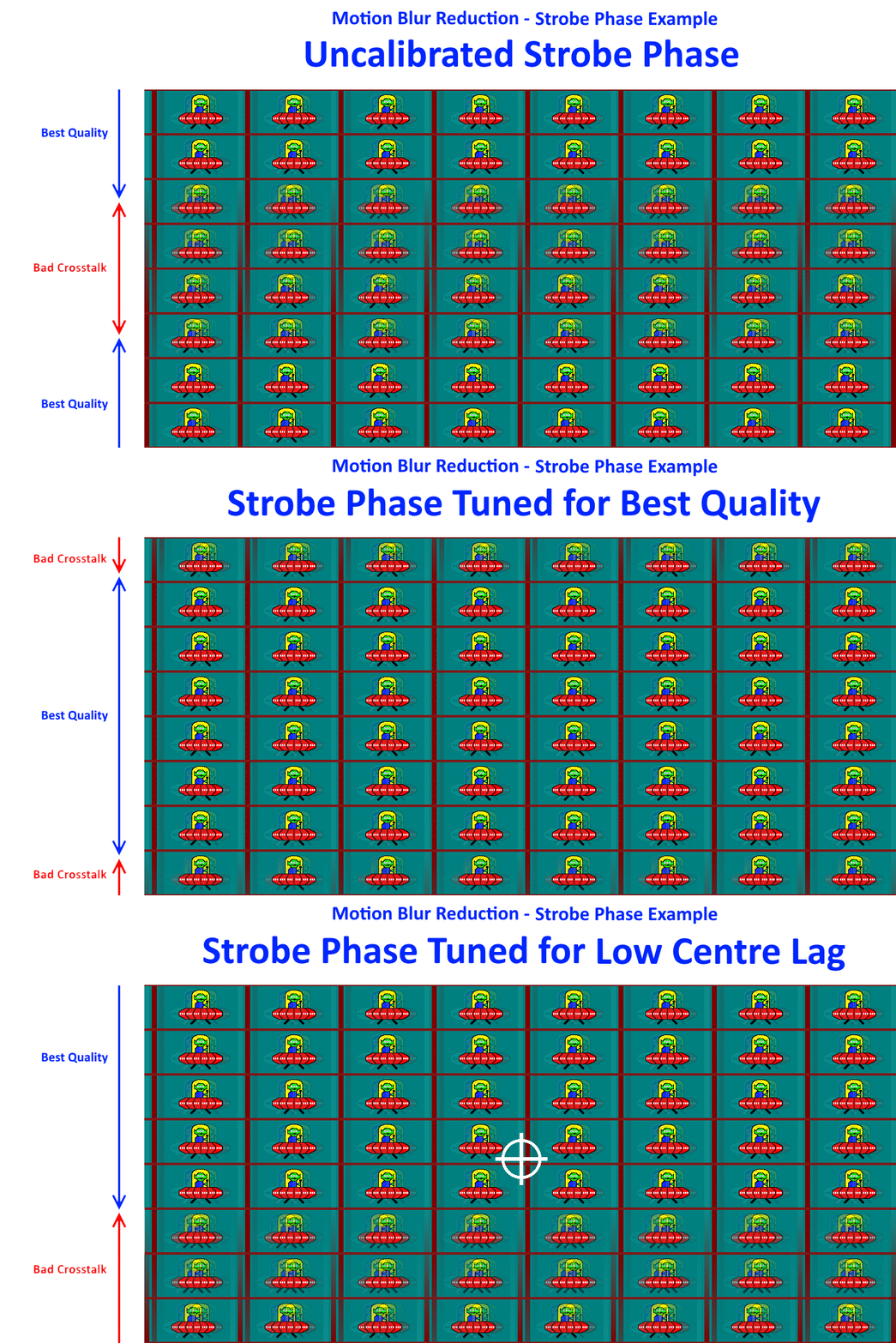
In your case for these image examples for 240Hz BenQ ZOWIE gaming monitors, (1) halve the latency numbers at the left, and (2) greatly thicken the crosstalk zone. So you're simply shifting the strobe latency gradient vertically, everytime you move the crosstalk zone.
The input lag of strobing is lowest right above the crosstalk zone as that has the lowest scanout latency (see
high speed videos of scanout lag). The crosstalk zone is essentially the scanout fade zone (GtG zone) that has been flashed instantaneously (essentially stroboscopically frozen in appearance). The ideal phase for picture quality (not center lag) is putting the crosstalk zone between refresh cycles -- that ends up putting the lowest-strobe-lag at bottom edge of the screen.
The latency gradients can interact with sync technologies in a weird way.
VSYNC OFF + nonstrobed = zero latency gradient (though each frameslice is a mini-lag-gradient)
VSYNC ON + nonstrobed = latency gradient that continually increases towards the bottom edge of the screen
VSYNC OFF + strobed = complex layered latency gradient, but generally on average decreases towards the bottom edge of the screen.
VSYNC ON + strobed = zero latency gradient (globally presentation at GPU level and at monitor level)
Glassfloor frametime + identical latency for whole screen surface -- is achieved with strobed VSYNC ON (or well-tuned RTSS Scanline Sync for games that can do framerates permanently above Hz .... RTSS Scanline Sync + low Hz strobing (100Hz-144Hz) is recommended for the CRT-nirvana lovers that don't mind a little extra lag but require glassfloor-consistent predictable input lag). Basically you're trading all those scanout latency gradient / frameslice gradient issues, for other things.
Absolute lowest average lag would be VSYNC OFF + nonstrobed, but obviously with other disadvantages like the crosstalk zone and the latency gradients which is extremely tiny at high refresh rates. It's really just a "Right Tool For The Right Job" situation.
Technical info: The crosstalk zone is much taller during 240Hz than at 120Hz, that's why it's so difficult to cleanly strobe 240Hz -- not enough time to "Cram the GtG elephant into the blanking interval"
</Advanced Information>