jlafarga wrote:Just like the title says people, I just read on wikipedia that LCDs can go as fast as 480hz, is this really true? and does the pixel size matter i.e. can a LCD with smaller pixels have faster refresh rates?
There's no real defined upper limit, just that the GtG becomes slower and slower when you have less time to inject voltage into pixels.
Blue-phase LCDs can refresh in microseconds, so could theoretically refresh far faster than standard TN / VA / IPS LCDs. However, these are still in the lab.
Did you know? LCD pixel response is actually independent of refresh rate.
We used to have 25ms and 33ms LCDs more than ten years ago -- that's longer than a refresh cycle at 60Hz (16.7ms).
See
High Speed Video of LCD Refresh Cycles.
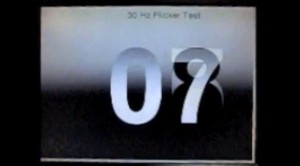
Here's an example of an old 2007 LCD with a real-world refresh that's noticeably slower than a refresh cycle.
When LCDs are too slow, they simply streak multiple refresh cycles into each other's refreshes.
You can have moments where there are three refresh cycles (refreshes displaying "06", "07" and "08") overlapping each other:
So you could theoretically have a 1000Hz LCD with a 33ms GtG.
Or a 60Hz LCD with a 1ms GtG.
GtG has nothing to do with the refresh rate (number of GtG transitions per second, or number of GtG direction changes per second essentially -- as subsequent refreshes can 'interrupt' the GtG momentum, since pixel transitions (GtG) actually physical momentum of LCD crystal (molecules) in motion sandwiched between layers glass. You inject voltage into a LCD pixel, and long after the voltage is finished, the GtG pixel transition is the physical momentum. You could theoretically inject a voltage into an LCD pixel for a picosecond, but you won't get much GtG momentum out of that, unless you raise the voltage hugely. Blue phase LCD's use extremely high voltages (>10 volts) injected into pixels, to speed up transitions. So the limiting factor is how well the LCD can be designed to accept a very high voltage per pixel for the maximum possible momentum imparted into liquid crystal in the shortest possible time, in order to refresh the next pixel (i.e. faster scan out speed). You can also speed things up by multi-scanning the LCD, too (which brings up a host of other problems)
As you can see in high speed video, essentially one pixel is refreshed at a time, but previous pixels are still "fading in" because of the momentum of the pixel transition. So it looks like a fuzzy "wipe" scan from top to bottom.