Excellent Educational Question
Be noted, scientifically:
1. ULMB is impulse driving.
2. Strobe backlights is impulse driving.
3. Strobe backlight is the only way to impulse-drive an LCD.
4. There are multiple strobe backlight brands (some better, some worse).
5. Remember I've seen thousands of displays. Strobe backlights can sometimes produce better motion quality than a CRT tube (i.e. Oculus Quest 2 LCD VR is among the best strobed LCDs I've ever seen).
Dead-Serious Question:
A. Have you ever seen a good strobe backlight before? As in REALLY compared 10 Or 100 models? I have. And some exceed CRT nowadays.
Strobe Backlights, in certain cases, can surpass CRT motion clarity
It is a false assumption that technologies similar to "ULMB" can't surpass CRT motion clarity. Sure, less than 1% of panels and strobe backlight settings can pull it off, but a well-tuned strobe backlight can produce a superior motion clarity experience. For example, a5hun's review of the Blur Busters Approved XG270 said that it produced better motion clarity than a Sony FQ900 at a very specific setting (119Hz-120Hz). Or the Oculus Quest 2 VR LCD or the Valve Index VR LCD. They are examples of strobe backlights that can (at times) surpass CRT motion clarity. Check out
ApertureGrille XG270 Tests of 119 Hz Versus CRT and you will see how there are some fewer artifacts than CRT (strobe crosstalk much fainter than CRT phosphor ghosting), thanks to my Blur Busters Approved work on XG270 (and soon, a few models this year will have the Blur Busters Approved seal). Sure, it doesn't make the LCDs perfect nor surpass CRTs in all ways (imperfect blacks etc), but they reach nearly the pinnacle of strobe quality at some settings, as much as the LCD technology is able to permits.
CRTs impulse driving are also a humankind band-aid too
CRT impulse driving is also a humankind band-aid, because real world doesn't strobe. So I kind of resent the use of the word "Band-Aid" used out-of-context to ULMB but not to CRT flicker. Reading the
Blur Busters Law: The Amazing Journey To Future 1000 Hz Displays, you will see how I say that
Impulse driving of any kinds is a human-kind band-aid because the world has not developed analog motion displays to emulate real life. The artificial humankind invention of a "frame rate" in the world of real life being framerateless, meant that impulse driving is a good bandaid to eliminate motion blur of non-analog motion (aka series of stationary pictures to emulate real life, but real life isn't a series of stationarynesses).
Impulse Driving the LCD Panel via Software BFI
Now, if you wanted to impulse-drive the LCD panel instead of the backlight, it can be done via software black frame insertion, as seen at
www.testufo.com/blackframes .... If you have a 240Hz display, view
www.testufo.com/blackframes#count=4&bonusufo=1 ... That's software-based impulse-driving. But notice it never is as clear as a CRT. It's bottlenecked by LCD GtG and refresh cycle granularity time (e.g. "decay" can be never faster than a refresh cycle).
High Speed Videos: Understanding LCD Scanout in High Speed Video
This is how an LCD looks like in a high speed video:
www.blurbusters.com/scanout .... Check these out and come back to this thread. In the past, LCD was very slow at refreshing. Here's a high speed video of an IPS LCD swapping 60 pictures per second:
See? You can't fit two GtGs per refresh cycle easily into that. Now, you've got faster/better LCDs that can do GtG almost as fast as an OLED, but still not quite fast enough to properly impulse-drive.
Theoretically Rolling Impulse Scan at the LCD Layer Level
Now, a custom LCD can theoretically multi-scan with an OFF scanout pass pass chasing the ON pass. I've got an
OLED Custom Scan Patterns Thread that covers this. An example is this one. LCDs currently don't do this at the moment (Two GtG operations per refresh cycle is the only way to impulse drive at sub-refresh levels, if you don't impulse-drive via the backlight instead)
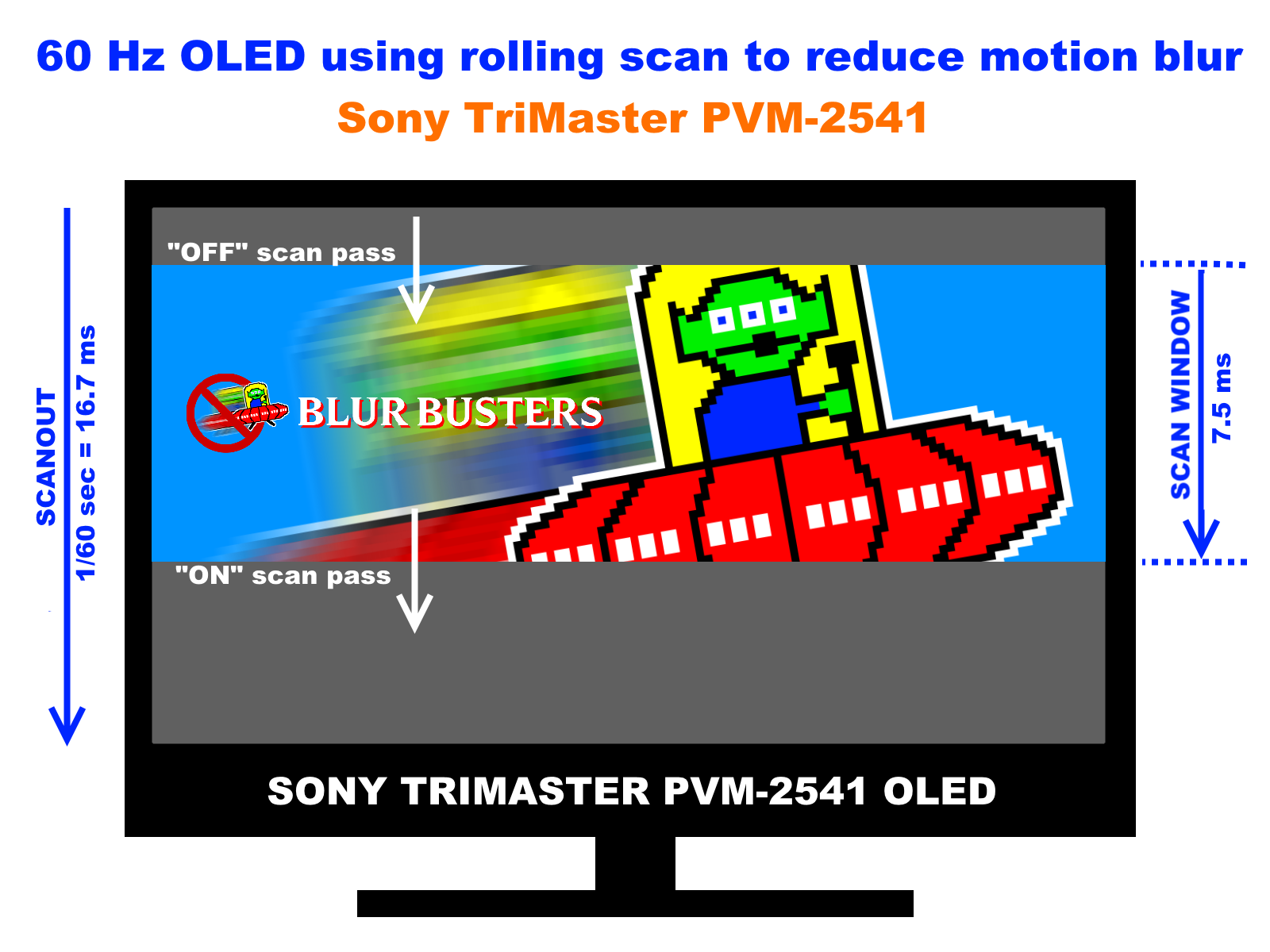 Impulse Driving Is Two GtGs Per Refresh Cycle
First GtG is black towards visible color
Second GtG is visible color back to black
Problem Trying To Impulse Drive Via LCD GtG: To Match CRT Clarity, Need 2 Super Fast GtG Per Hz
Pixel transitions (GtG) is a pixel fading from one color to the next. Even "1ms GtG" may be 10ms real world, see
GtG vs MPRT: FAQ About Pixel Response. So to match CRT motion clarity with LCD-layer-based GtG impulse-driving you need GtG 100% to be 1ms for all possible color combinations, which is darn near nigh impossible. You need sub-millisecond GtG100% from black-to-color. Then another 2nd sub-millisecond GtG100% from color-back-to-black WITHIN the same refresh cycle to black out the pixel quickly.
The CRT Version of GtG
Even though we don't call it "GtG", CRTs have a metaphorical equivalent of GtG too:
The 1st GtG of a CRT for off-to-on is extremely fast (microseconds), the electron beam illuminating the phosphor dot.
The 2nd GtG for a CRT for on-to-off is the slower phosphor decay (still often decays 90% within a millisecond).
For LCDs, It Is Easier To Do Impulse Driving (Two GtGs Per Hz) Via Backlight
Backlights can turn on/off faster at much higher quality than trying to impulse-drive via LCD GtG. If you compare software BFI with hardware strobing, the quality of most hardware strobing can be superior on most panels.
More Reading -- References- Blur Busters Law: The Amazing Journey To Future 1000Hz Displays
- Pixel Response FAQ: GtG Versus MPRT
- High Speed Videos of LCD Refreshing
- The Stroboscopic Effect Of Finite Frame Rates
- Very Old 2014 Article: Electronics Hacking Creating A Strobe Backlight
For even more, study the great articles at Area51 --
www.blurbusters.com/area51 -- to gain a better understanding of displays.
Shopping Guides For Better LCD Impulse Driving (Via Strobe Backlight)
-
CRT Nirvana Guide for DIsappointed CRT-to-LCD Upgraders
-
Good News Everyone, 60 Hz Single Strobe Options