Alcazar wrote:New user here, love the site topic! Really glad there's a place to discuss this stuff here. I used to run 120hz as a pro quake gamer and really miss the days of silky smooth PC gaming video.
CRT's had an obvious need for refresh rates because there's an oscillating cathode ray tube running the image. But why do LCD displays need refresh rates at all? You could get rid of G-SYNC, V-SYNC, 30/60/120hz discussions, tearing, and framerate caps altogether if you could remove the refresh rate requirement entirely.
Why must a GPU be talking to a LCD monitor at some predetermined frequency? Couldn't the GPU just send a new frame to the monitor "when it's ready" and get us a perfect tear-free low-lag image every time? I'm sortof baffled this hasn't happened yet. Comments?
Alcazar, welcome to the forums!
Terminology Confusion: "strobing", "impulsing", "flicker", etc
Here at Blur Busters, we define "strobing" as light modulation of all kinds (including CRT phosphor). Unfortunately, it is extremly difficult to come up with a single terminology that every User agrees, to describe light-modulated displays. Do we call them "flicker displays"? Do we call them "strobed displays"? The terminology gotcha exists because flicker is not always visible to the eye (e.g. 120Hz looks flickerfree to a lot of us). And strobing is mainly described to describe a brief photographic-style flash rather than an electron gun. And not everyone understands "impulse driving". However, strobing essentially occurs at the pixel level on a CRT, since each pixel flashes only once per refresh (phosphor illuminate-and-decay cycle), so I consider CRTs as a form of a strobed display too, albiet a reinterpretation of strobing, as not the whole display strobes at once, but only at the electron dot level. But it's still one effective strobe per pixel per refresh, the same motion-blur-killing principle that exists on all lower-persistence displays (no matter the technology). Thusly, the terminology we use here at Blur Busters for all persistence-lowering light-modulated displays (black frame insertion, CRT phosphor, LCD strobe-backlight, etc), is often called "impulse driving".
CRT-motion-clarity LCDs are already here, via strobe backlight operation
Some old-time LCD luddites still don't believe LCDs ability to become truly impulse driven, but the era is here already. What matters is what the human eye sees. The human eye sees impulses of light regardless of what rube-goldberg mechanism the display uses...
e.g. CRT = vaccuum-filled glass ballons with ray guns hitting special glowing substances
e.g. strobe LCD = panes of glass sandwiching polarizers and liquid crystal substance, with a flashing backlight behind them
They are both legitimately true impulse-driven displays, from a human vision perspective. There can be artifacts (e.g. CRT phosphor ghosting, LCD strobe crosstalk) but they are outside the scope of this discussion, and displays now exist where either of those are below human-detectability-levels during regular motion material.
Most LCDs do not flicker/impulse. There is more motion blur on all flickerfree displays
Flicker Displays: Motion blur is always equal to the length of the flicker, one flash per refresh
Flickerfree Displays: Motion blur is always equal to the length of frame cycle.
Persistence is the amount of time a frame is visible for per refresh
Flicker Displays: Persistence is the length of the flicker, one flash per refresh
Flickerfree Displays: Persistence is the length of the full refresh cycle
Motion blur formula: 1ms of persistence equals 1 pixel of motion blur during 1000 pixels/second.
This assumes framerate-refreshrate synchronized motion, and this formula is more accurate for squarewave persistence, but this is a very good rule of thumb easily observed via
TestUFO black frame duty cycles comparision (view this in LCD non-strobe mode), and also compared in the chart below:
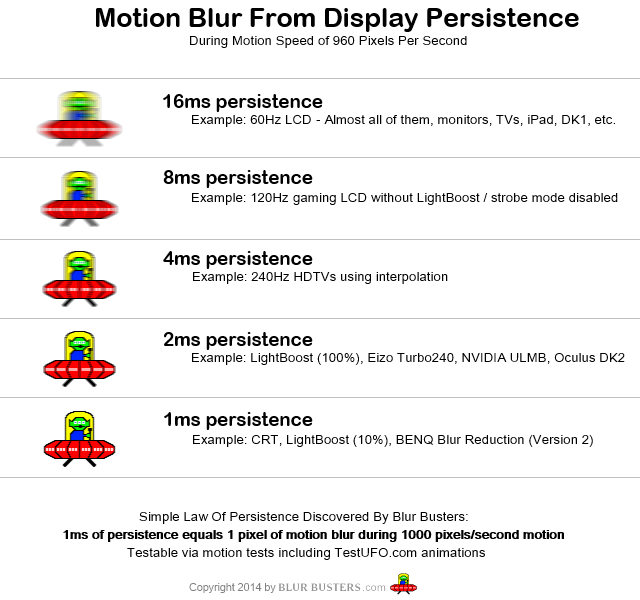 Increasing Refresh Rate on flicker displays have less effect on motion blur
60Hz with 1ms flicker (strobe or phosphor) = 1ms persistence = 1 pixel motion blur for 1000 pixels/sec
120Hz with 1ms flicker (strobe or phosphor) = 1ms persistence = 1 pixel motion blur for 1000 pixels/sec
60Hz flickerfree = 1/60sec = 16.7ms persistence = 16.7 pixels motion blur for 1000 pixels/sec
120Hz flickerfree = 1/120sec = 8.3ms persistence = 8.3 pixels motion blur for 1000 pixels/sec
So going from 60fps@60Hz CRT to 120fps@120Hz CRT has no difference in motion blur, but going from 60fps@60Hz flickerfree LCD to 120fps@120Hz flickerfre LCD has 50% less motion blur. According to motion blur mathematics, this is correct. And this is accurately observed in TestUFO.com motion tests both on CRT and LCD.
A similiar thing happens when you use BENQ Z-Series strobe with Blur Busters Strobe Utility, using 1ms strobing at 60Hz versus 1ms strobing at 120Hz creates a similar amount of motion blur (just like on a CRT). Adjustable-persistence strobe-backlight monitors are very educational to vision researchers, watching motion tests (e.g. the various 15 selectable motion tests at at top of TestUFO.com) while adjusting persistence on the fly.
Problems of Finite Refresh Rates Are The Same for LCD and CRT
There is another effect other than motion blur. It's called the stroboscopic effect, also known as the phantom array effect. Even CRTs still has "stroboscopic effects" indirectly (mouse dropping effects, wagonwheel effects, stroboscopic effects, etc). Look at
the stroboscopic effect explanation that all finite-refresh-rate display. This visual effect is UNSOLVABLE with finite-framerate displays, without going to ultrahigh refresh rates (e.g. 1000fps+) or infinite framerate equivalents (continuous-motion displays with no static frames for a single nanosecond).
We Still Need Refresh Rates Due To Technological Limitations
It's scientifically not currently possible to record & playback motion on a display in a framerateless manner (infinite framerate / continuous-motion displays). Also, even refresh rates on CRTs still creates the stroboscopic side effect (phantom array effect), see above, so we likely can't reproduce real life (Holodeck quality) on a display within our lifetimes. We can get really close, though. Getting closer and closer, but not quite reaching it, like trying to accelerate to the speed of light.
Educational References
 ) The electron canon should be able to be controlled quite precisely. Of course it would be an extreme flicker-fest below 50Hz.