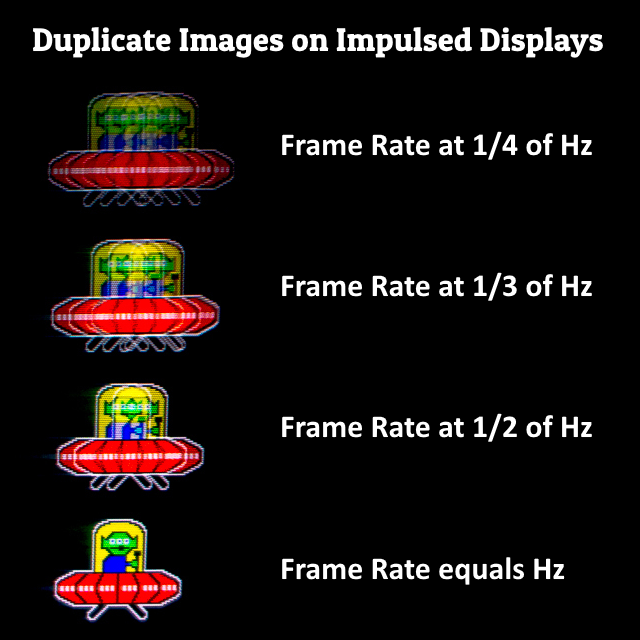
Tim42 wrote: ↑03 May 2022, 06:18
Does anyone have an explanation for the effect John describes?
Welcome!
You’ve posted in the correct forums — and the above posters are (more or less) correct.
However, there’s additional human psychovisual factors that creates a double-image optical illusion on a perfect sample-and-hold display (no impulsing) — much in the same way that sometimes a vibrating string on a guitar looks like two strings. (stutter = a form of vibration around the human eye gaze axis)
Perfect sample-and-hold display (GtG=0ms) means 60fps looks perfectly identical at 60Hz, 120Hz, 180Hz, etc.
However, GtG curves can be different for 60Hz and 120Hz.
There is yet another cause: The fast GtG curve of OLED can raise the threshold of “slideshow to motion”. That’s why 60fps stutters more on an OLED than on a slow LCD.
Slower GtG lowers the threshold of stutter detectability (even for perfect frame pacing).
It is a complete continuum from stutter-to-blur:
www.testufo.com/eyetracking#speed=-1
This is also observed in framerate ramping on VRR;
www.testufo.com/vrr where low framerates looks like stutter and high framerates, the stutter amplitude becomes the blur amplitude (stutter and blur are the same thing: persistence …. And the variable is the frequency, aka the frame rate). Like how a slow-vibrating string vibrates visibly, and a fast-vibrating string blends into blur. Motion on a display (during eye-tracking situation) is the same.
A fast GtG will raise the framerate threshold of where stutter blends to blur, and vice versa. (be noted, the specific human will vary in threshold — the stutter blending to blur is related to a specific human’s flicker fusion threshold)
A faster-GtG display will raise the framerate where stutter goes too fast and blends to blur (like a fast vibrating guitar string).
The non-impulsed two-image effect can also be caused by the interpretation of the extremities of the stutter amplitude — the outer extremes of the stutter-vibration around the axis of the moving eye gaze.
This produces a phantom double-image effect even on a perfect 0ms GtG sample-and-hold display. This is also sort of observed at lower frame rates on LCDs too, at approximately ~20fps-ish though some humans say they see it in 30fps-ish, and others, 40fps or 60fps.
Concidentially, OLED displays have the highest threshold where stutter blends to blur, and some humans still see stutter on OLEDs at 60fps 60Hz, because the stutter-to-blur continuum threshold is above the number 60 for that specific human for that specific display (OLED).
You can watch the RTINGS video to understand how stutter and persistence blur are exactly the same thing:
Since this is a display physics question, I have moved this thread to the Area 51 forum.
More testing is needed for measuring the stutter-to-blur continuum thresholds for humans, because it is affected by many variables (the specific human’s flicker fusion threshold, the specific display GtG curve behavior, etc) but a common way to determine this is to watch a VRR framerate ramping animation and decide which framerate threshold — whereupon below is stutter and above is blur.
Sample-and-hold persistence blur is simply stutter vibrating too fast that it blends to blur (like a fast-vibrate guitar string) … that’s why fast-vibrating strings sometimes looks like two strings too.
(For simplicty’s sake: Assumes perfect frame pacing, and no VSYNC-related stutter — just stutter because of too-low framerate)
A related thread on retina refresh rate thresholds are:
Human Visible Sensitivity Thresholds