

Upon popular demand, and confirmation of accuracy, we've made tick mark count configurable at www.testufo.com/ghosting
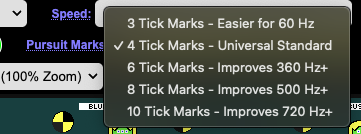
This makes it much easier to use shorter exposure speeds for low Hz (e.g. 1/20sec shutter for 60Hz) and longer exposures for high Hz (e.g. 1/100sec shutter for 1000Hz), in order to stay reasonably close to human vision averaging behaviors.
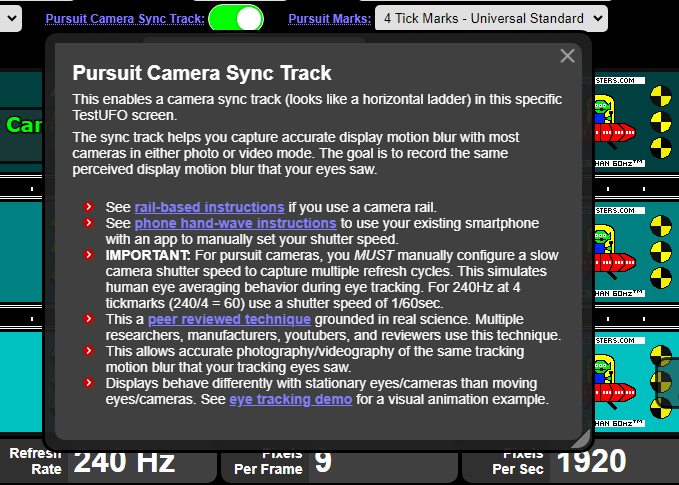
There's also improved tooltip instructions at TestUFO Ghosting, that can help with instructions for users of TestUFO Ghosting:
Hope this helps!
Known Error Margin - Disclosures
Some researchers/scientists ask if results degrade with permitting large ranges of shutter speeds.
We find the TL;DR is no for most displays.
That's because for a continued pursuit at extreme high frame rates at high rerfresh rates -- motion blur generally looks the same. The more refresh cycles captured, the more it's blended/averaged. Beyond a certain point (but as long as pursuit is accurately tracked), capturing 3 to 8 refresh cycles look identical to each other in resulting photos if you pursuited perfectly.
The main error margins tended to be:
1. Camera shutter that isn't an integer multiple of refresh cycles, on displays that have subfield modulations (temporals/dithers/FRC/strobing/phosphor decay/etc). Cameras are not aligning shutter capture with the refresh cycle, but as long as you're at the same percentage through the leading refresh cycle and the trailing refresh cycle (e.g. 1/30sec shutter for 120Hz), you're capturing the same temporals because the majority of displays are doing the same refreshing algorithm for the first refresh cycle and the last refresh cycle, so the first/last seamlessly splice together. Being that said, for most LCD/OLED which are sample and hold without much visible modulation through its refreshtime (there's some -- but it averages well below most human perception noise floor). You can get away without needing an exact integer multiple shutter time versus refresh time, but -- best practice is to keep it integer multiple.
2. Temporal dithering or FRC algorithms. This is more for full binary flicker (e.g. DLP) or extreme bright subfields (e.g. Plasma) than for LCDs, since LCDs are flickering adjacent 8-bit colors to generate 10-bit for example. This will generally be far below noise floor in overall averaging, because we're focussing on the motion blurs (spatials perceived during an eye track) rather than the temporal modulations seen during a pursuit. Since FRC/dithers usually use even-number subfields, try to
3. Old displays + odd number captures. Some LCD displays has strong voltage inversion that flickers badly. For most accurate averaging of these, use even-number refresh cycle capture (e.g. 4). Modern LCDs generally don't have extreme strong flicker from LCD inversion so odd-numbered refresh cycles produce identical results to even-numbered refresh cycles.
4. More camera shake (aberrations from perfect pursuts) over the time duration when capturing too many refresh cycles (but generally not an issue when refresh cycles are ultra-brief, like 480Hz).
5. Motion speeds not perfectly divisible. This can produce a small % difference in motion blur that can easily be accomodated/acknowledged. For example, 720Hz displays trying to do 960 pixels/sec will require large aberration in motionspeed (if integer pixel step per refresh) or faster motion speed to get smaller aberrations (e.g. targetting 1920 pixels/sec and getting actual 2160 pixels/sec) or non-integer motion speed (but getting subpixel scaling artifacts or jitter when trying to do non-divisible pixels per frame).
Older error margins were already discussed at other locations, as well as in the original pursuit camera articles / papers.
Additional Pursuit Best Practices
Best practices is to make sure that you photograph a sync track both ABOVE and BELOW the image. This avoids things result distortions from things like camera tilt, camera rotation, partial display scanouts, camera rolling shutter artifacts, etc -- by making sure you have identical sync track results at all four corners of your measured photography image.
This is especially important if using the pursuit camera method for MPRT measurements (e.g. www.testufo.com/mprt ...) or traditional scientific blur-edge measurements (e.g. www.testufo.com/blurtrail ) ...
With higher Hz, comes the need for higher motion speeds such as 1920 pixels per second. This is more challenging to manually pursuit, but it is also convenient that displays are also higher resolution (1440p and 4K), which makes 1920 pixels per second a bit slower than on a 1080p display. See www.blurbusters.com/why960 for why 960 pixels per second was long standardized -- as the number nearest to 1000 pixels/sec that is still divisible by common refresh rates (60, 120, 240, 480) -- but 1920 pixels second is now needed to distinguish motion blur of even higher-Hz displays of emerging 720Hz and 1000Hz displays.
It is important to capture using landscape camera (phones should be held horizontally if using a phone-based sensors), as rolling shutter error margins (interacting with display rolling scan) cancel out during the averaging process (and only shows as a minor scanskew -- www.testufo.com/scanskew -- which is generally not a problem for things like blur edge measurements and pursuit camera photography of horizontal motion). By keeping the scanout direction identical between display and camera, regardless of scan velocity differences, it is convenient that the long exposure averages this out in the vast majority of cases.
Some entities (VESA) use high speed cameras, but catering to content creators requires ability to accomodate inexpensive equipment. We've able to confirm that, properly done, even a $100 smartphone manages have sufficient quality to capture <0.5ms MPRT error margins.
Commentary Welcome
I welcome further research/papers from others on this matter. Over the last 10 years, we've found that allowing a range of 3-10 exposures is fine for the pursuit camera sync track, as an analog to human vision averaging behaviors (vision integration).
The Blur Busters pursuit camera is still the low-cost gold standard even a decade later... (And you can still use it with motorized or automated cameras, if need be).
Tracking Accuracy Ground Truth Embedded In Results
About a decade ago, a peer reviewed conference paper was created with NOKIA, Keltek, NIST researchers - Pursuit Camera Conference Paper.
The sync track is the ground truth regardless of how it's pursuit by the >1000+ content creators in over 50 countries.
Rail-less Methods Unexpectedly Accurate
(e.g. Hand Waved Smartphones With Good Cameras)
Embedding camera tracking accuracy ground truth into the same images that are being analyzed, means there is a focus on how accurately the captured image is regardless of how it was pursuited. This has led to experimentation of multiple manual ways of doing pursuit-camera.
It is impressive that users of the pursuit camera method, has come up with ingenious ways to do pursuit camera, including smartphone handwaves with a motion-stabilized iPhone/Android phone using high-quality/uncompressed/ProRes video (in a third party camera app) as a stand-in for burst photo shooting.
Many of these handwaved pursuit images actually exceeded rail-quality because more error margins reduced than added error margins. Certain things (e.g. optical stabilization/avoiding shaky tripods/rail vibrations) improved accuracy more than added new error margins (e.g. handshake)
A good camera rail with strong anchors (e.g. mounted to stiff blocks/vises rather than shaky flexible tripods) will generally usually outperform. Being that said, technology in smartphones have improved so much (e.g. resolution, optical stabilization, light weight, RAW/ProRes modes, brute-force burst shoot of over 1000 images per minute by using video as a burst shoot substitute).
It has become now a legitimate alternative for content creators to use railless methods of pursuit cameras -- especially for field measurements where you don't have the luxury of setup/teardown. And still getting sub-millisecond pursuit camera precision with sub-1% tracking error margins (in some cases, sub-0.1%) from experts from the actual observed results out in the field.
