urut wrote:Thanks alot !
But is any diffrence between 1350vt trick and 1502vt trick?
The short answer:
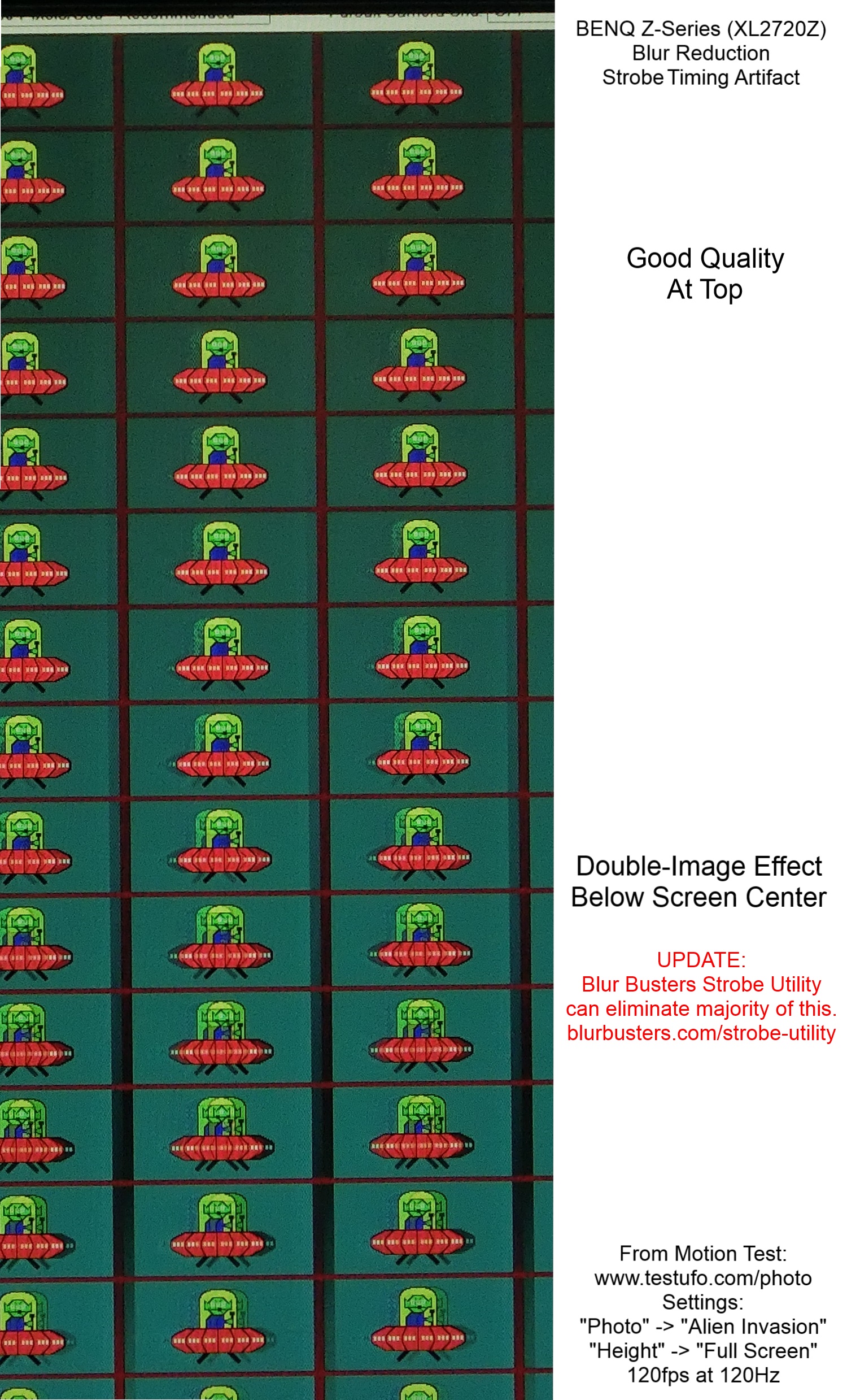
Vertical total tricks are used to help the LCD finish refreshing more completely before made visible to human eye (by strobe backlight flash). Thus, less ghosting shows up with larger vertical totals.
The long answer:
The bigger the vertical total, the less strobe crosstalk occurs. Less double-ghosting effect occurs. The bigger the better, but it pushes the dotclock closer to the monitor's limits and colors might degrade slightly while motion clarity improves.
Vertical Total 1350 creates a pause of (1350-1080)/1080th of a refresh inserted between refresh cycle, which is a longer pause between refreshes to let the LCD GtG pixels settle before the backlight flashes again.
You can see a
high speed video of a strobe backlight to understand how a LCD refreshes. A strobe backlight is used to reduce motion blur. To do so, the backlight (in LightBoost, ULMB, Turbo240 or BENQ Blur Reduction) needs to flash briefly once a refresh, 120 times a second (like a flickering CRT). Shorter flashes, shorter persistence, less motion blur, clearer motion.
However, because of LCD grey-to-grey pixel transitions (as well as ghosting/overdrive/coronas), if you flash the backlight while the LCD pixels aren't finished transitioning, you get
strobe crosstalk. So a monitor needs to precisely time the flash of the backlight between refreshes. Usually the pause between refreshes is only about half a millisecond -- that's not enough time to let LCD GtG pixel transitions to finish. Unfortunately, without vertical total tweaks (required for BENQ BR) or special monitor behavior (LightBoost uses partial buffering and accelerated LCD scan-out). So these kinds of Vertical Total tricks is used to create longer blanking intervals between refreshes (If you know of an old analog TV with a rolling picture -- larger Vertical Totals is akin to thickening that black VHOLD bar between frames). This creates a much longer pause - between 2 and 3 milliseconds - between monitor refreshes. This lets monitor LCD pixel transitions finish in total darkness between refreshes, before the backlight is strobed on more fully refreshed frames -- reducing strobe crosstalk, sometimes to nearly zero.
Often, 2 to 3 milliseconds is usually enough to hide the vast majority of ghosting in a 1ms GtG monitor panel. So VT1502 (A 1502-scanline signal for a 1080p refresh cycle) is really good for producing ultra-clear motion without double-image ghosting effects, because 1/3rd of the time is essentially spent waiting between refreshes, since the screen is scanned out in only 1080/1502ths of a 1/120sec, leaving the remainder to wait for the pixels to finish transitioning (GtG, as in grey-to-grey, the pixel change from old color value to new color value). Most 120Hz gaming monitors are rated at 1ms GtG, though real-world is often longer than that.
Modern LCDs now have GtG ratings (1ms) far shorter than an LCD refresh cycle (1/120sec = 8ms). Ever since this happened, it made highly-efficient modern strobe backlights possible.
 Thanks a lot!