Page 8 of 154
Re: NVIDIA G-Sync Pulsar monitor - Asus ROG Strix XG27AQNGV
Posted: 10 Jan 2026, 13:23
by Discorz
OK so turns out the secondary pulse they're using for the compensation is actually spotable. I just realized
MUB ufos are moving at faster ~1920 and not 960 px/sec as he said. On a classic single-strobe that would normally translate to wider spacing between the primary and ghost images, but they appear to be as tight as at ~960 px/sec. Which means the primary ghost image is coming from the secondary compensation pulse between the frames. So it's kind of a double-strobe VRR, but a softer one.
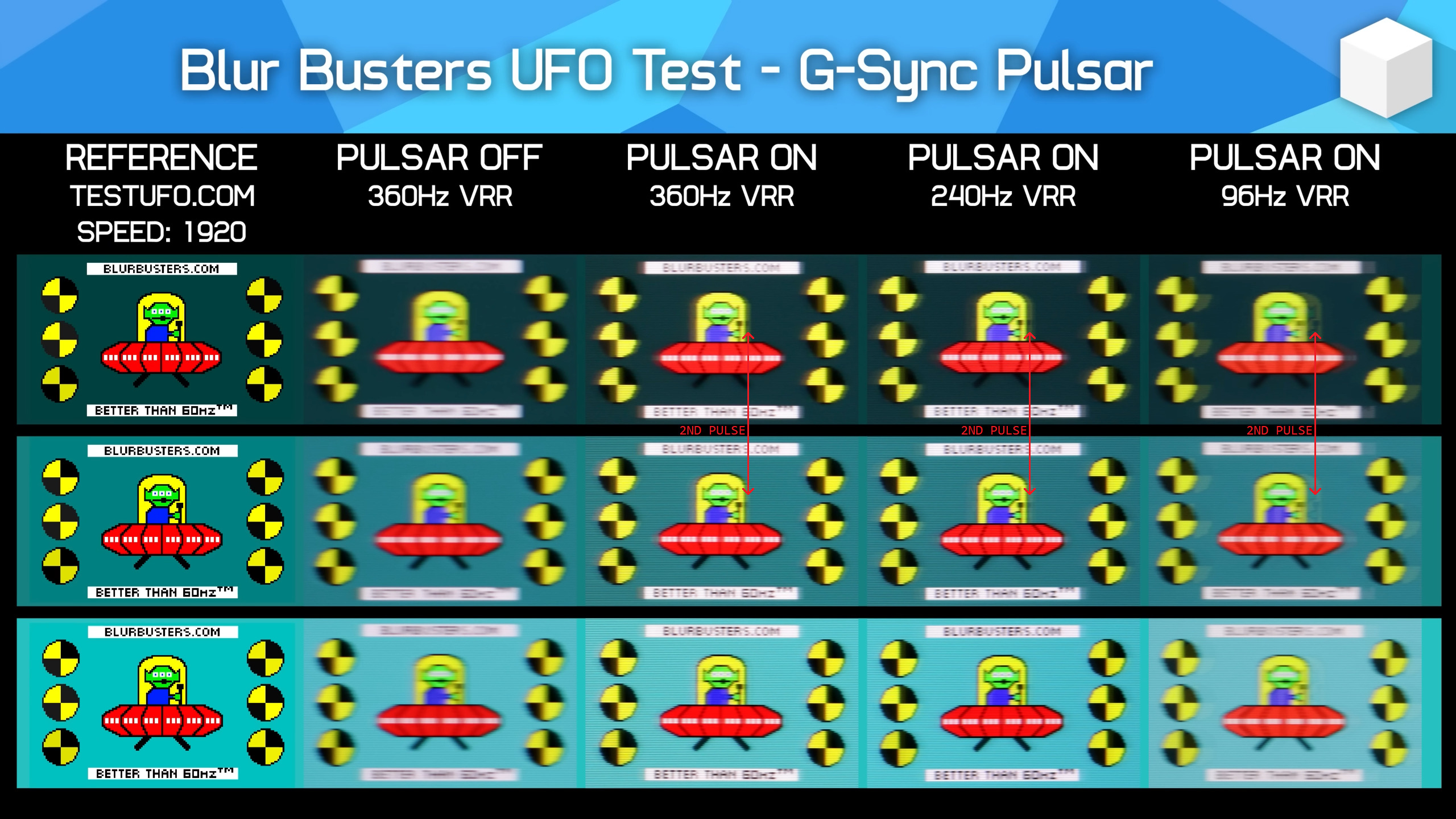
- MUB Pulsar UFOs.jpg (814.14 KiB) Viewed 4626 times
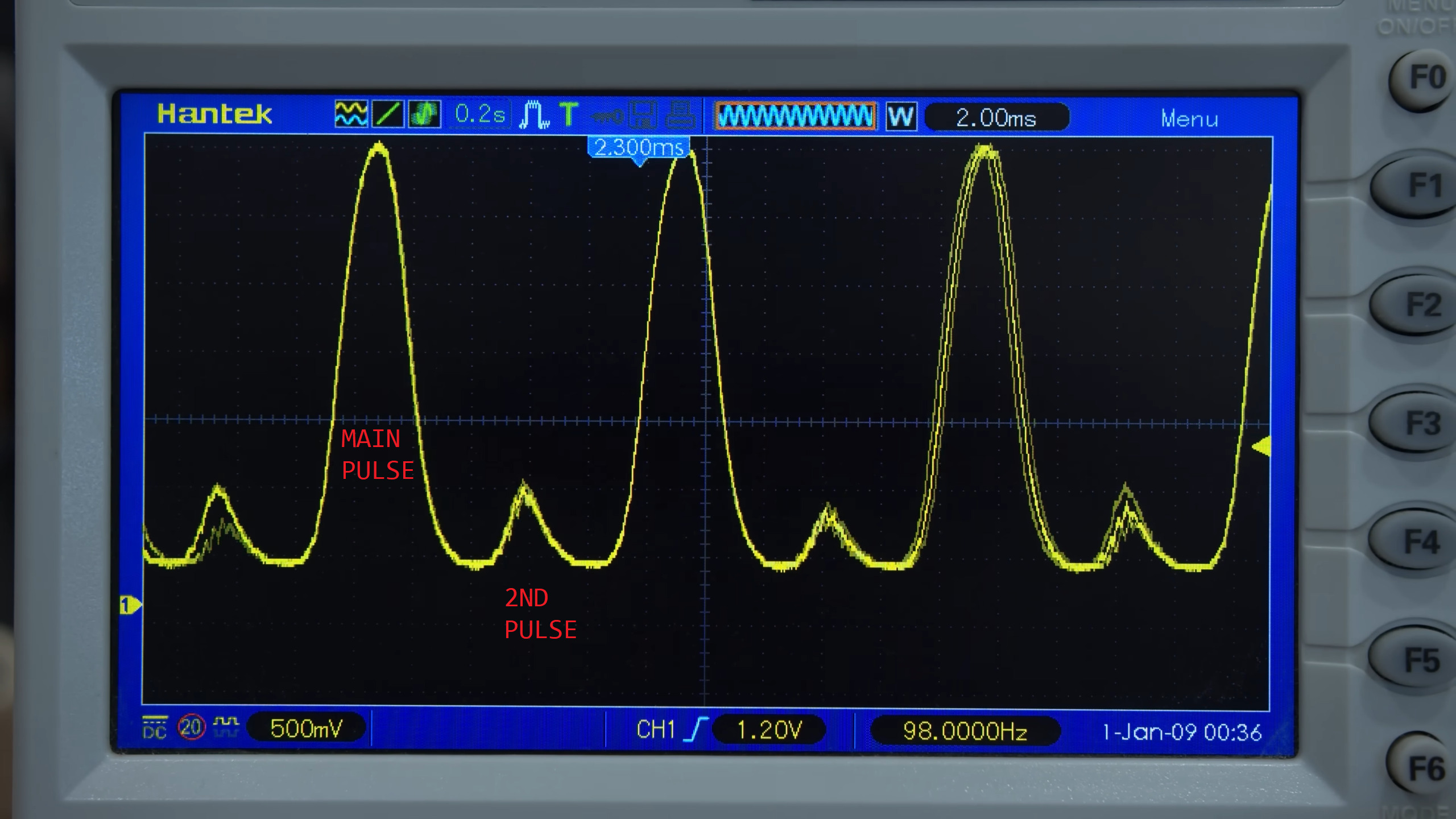
- MUB Pulsar 98 Hz fps.jpg (532.17 KiB) Viewed 4626 times
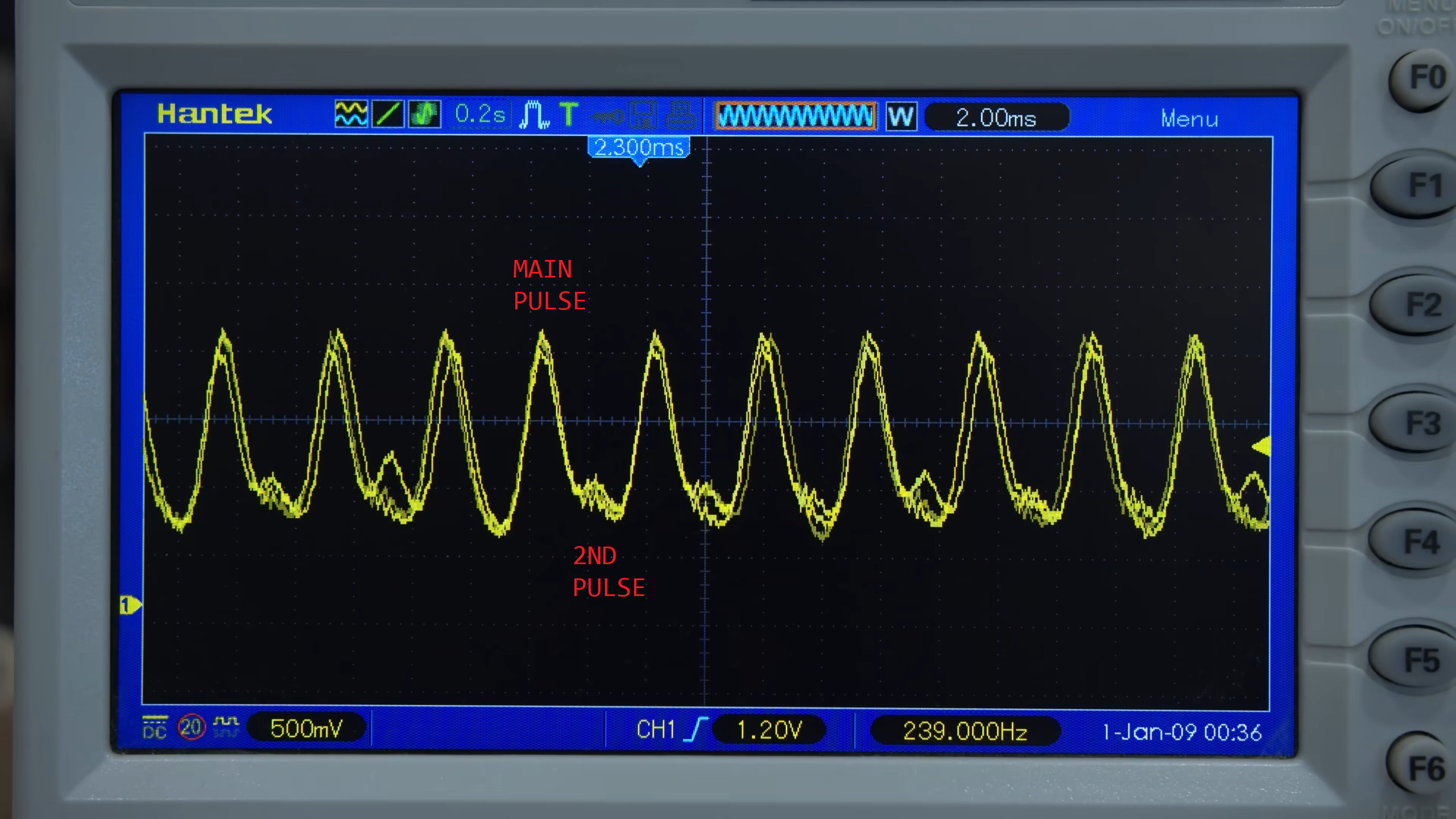
- MUB Pulsar 239 Hz fps.jpg (584.91 KiB) Viewed 4626 times
https://youtu.be/SXwXGYhi8_I?si=CwuSPdg4Yn_2P7ku&t=968
So if I'm thinking right ULMB (without g-sync) on these monitors won't have as much artifacts. Anyone tried it?
Re: NVIDIA G-Sync Pulsar monitor - Asus ROG Strix XG27AQNGV
Posted: 10 Jan 2026, 15:26
by radeko
What for is this second strobe? Od how long it take to return to 1 strobe?
Re: NVIDIA G-Sync Pulsar monitor - Asus ROG Strix XG27AQNGV
Posted: 10 Jan 2026, 17:51
by Discorz
radeko wrote: ↑10 Jan 2026, 15:26
What for is this second strobe?
I actually have no idea why is there a second pulse. If they managed to pull off variable amplitude (pulse height), then why not let the main pulse do all the compensation? Chief, you here? May you chime in?
radeko wrote: ↑10 Jan 2026, 15:26
How long it takes to return to 1 strobe?
Frame rates in Smooth Frog (the program MUB captured ufos in) are very consistent, and yet the second pulse is still visible. So I'm not sure if it ever goes away. But this is what MUB said:
Monitors Unboxed wrote:"In the event of a large change in frame rate, the screen gets blurrier for a second or so. But then what you see is the screen appers to quickly clear up if the new frame rate is roughly maintained with no additional large flctuations."
Re: NVIDIA G-Sync Pulsar monitor - Asus ROG Strix XG27AQNGV
Posted: 10 Jan 2026, 20:43
by William Sokol Erhard
Discorz wrote: ↑10 Jan 2026, 17:51
I actually have no idea why is there a second pulse. If they managed to pull off variable amplitude (pulse height), then why not let the main pulse do all the compensation? Chief, you here? May you chime in?
radeko wrote: ↑10 Jan 2026, 15:26
How long it takes to return to 1 strobe?
Frame rates in Smooth Frog (the program MUB captured ufos in) are very consistent, and yet the second pulse is still visible. So I'm not sure if it ever goes away. But this is what MUB said:
Monitors Unboxed wrote:"In the event of a large change in frame rate, the screen gets blurrier for a second or so. But then what you see is the screen appers to quickly clear up if the new frame rate is roughly maintained with no additional large flctuations."
My expectation is that the second compensation strobe is the "high frequency" compensation that Nvidia's engineers were talking about when they said it took them a decade then they ran into an 'unsolvable' problem until they found this workaround.
The second compensation strobe is because if they compensated in the next regular main strobe instead, the human vision persistence wouldn't last long enough to hide the change in average luminance and you would see a change in brightness that would seem like a visible flicker.
That would align with the oscilloscope reading and the result Monitors Unboxed says about the screen getting blurrier during this compensation strobe. The secondary compensation strobe would essentially increase persistence and make a little bit of a double image leading to perceived blur which would be far less obtrusive than low frequency flicker.
Re: NVIDIA G-Sync Pulsar monitor - Asus ROG Strix XG27AQNGV
Posted: 10 Jan 2026, 22:28
by liquidshadowfox
I agree with the above and ULMB without Gsync enabled looks a little clearer than gsync pulsar to my eye, not sure if they disabled the secondary pulse but it does look a little clearer. It just really sucks I can't enable ULMB2 on my pg27aqn AND keep gsync pulsar on my new display to compare.
Re: NVIDIA G-Sync Pulsar monitor - Asus ROG Strix XG27AQNGV
Posted: 11 Jan 2026, 02:36
by twisterr
liquidshadowfox wrote: ↑10 Jan 2026, 22:28
I agree with the above and ULMB without Gsync enabled looks a little clearer than gsync pulsar to my eye, not sure if they disabled the secondary pulse but it does look a little clearer. It just really sucks I can't enable ULMB2 on my pg27aqn AND keep gsync pulsar on my new display to compare.
this pulsar tech is probably the best, but unfortunately, or fortunately (if you like IPS) its wasted on a slow IPS panel, imagine this on pg248qp but 1440p
Re: NVIDIA G-Sync Pulsar monitor - Asus ROG Strix XG27AQNGV
Posted: 11 Jan 2026, 03:24
by Baron of Sun
But isn't that just a problem with strongly fluctuating framerates? As MonitorsUnboxed showed the second strobe almost disappears when the framerate becomes stable. For me it sounds like a legit workaround to reduce flicker due to brightness fluctuations. Developers still have to get their frame pacing right. Pulsar cannot solve all of their problems.
Re: NVIDIA G-Sync Pulsar monitor - Asus ROG Strix XG27AQNGV
Posted: 11 Jan 2026, 09:49
by passballtotucker
This monitor is almost too bright at max brightness. There’s definitely some headroom to lower the brightness for more motion clarity. I really hope they enable this option.
Re: NVIDIA G-Sync Pulsar monitor - Asus ROG Strix XG27AQNGV
Posted: 11 Jan 2026, 10:12
by mango87
It seems the XG2431 is still worth keeping for 60hz content. With PureXP+ at extreme, the visual clarity is superior than gsync pulsar at 25% duty cycle, assuming Nvidia will add 60hz support soon. Gsync-pulsar seems to be designed for gamers who play shooters with high fps, and that's disappointing for low fps content.
Re: NVIDIA G-Sync Pulsar monitor - Asus ROG Strix XG27AQNGV
Posted: 11 Jan 2026, 11:36
by liquidshadowfox
I wonder if they will ever let us lower the duty cycle to 10%, hell I'd even take 15%! it looks so clear compared to a regular Gsync display and surpases OLEDs in motion clarity in general (and at lower refreshes). I would be happy if they at least give us the option to get the option to take the risk of more flicker in exchange for the 10%-15% duty cycle.