Is Bodnar input lag tester accurate?
Posted: 17 Apr 2014, 23:10
I recently learned about the Leo Bodnar input lag tester-- but the values I've seen for Leo Bodnar seem really out of whack with photo testing. Are Bodnar numbers accurate? Here are the things that make me suspicious:
1) Everybody always said that CRTs have no display lag (except from the scan line). This was because CRTs didn't have miles of circuitry for electrons to travel or any memory for buffers, I believe-- so the only possible lag could have been from the speed of electrons, which is high. But then Leo Bodnar tests came out and almost universally saw larger input lags than CRT comparisons did, and it looks like the explanations changed: the reason Bodnar numbers are higher is because they include lag that would be ignored with a comparison.
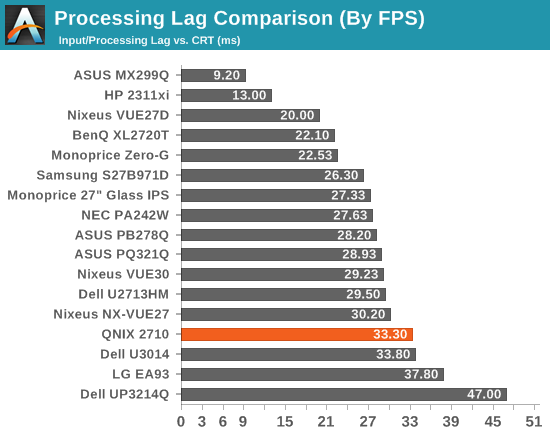
2) Although most Bodnar numbers are higher than the historical CRT comparison, a few are suspiciously low. Look at http://images.anandtech.com/graphs/graph7931/62611.png which is a chart comparing input lag, as measured by Bodnar tester, across monitors. Supposedly, it is an average value-- which I take to mean that it averages top, middle, and bottom of the screen. But the MX299Q is a 60hz monitor. Even with no extra lag, scan line lag should mean an average of 8.33 ms input lag. More, if previous comparison were flawed because they ignored the lag of comparison displays, then monitors with low lags by Bodnar should have been showing negative input lag, and they never did.
I would be less suspicious if Bodnar's tester wasn't such a clear convenience, or if those using it went into more detail with their methodology. Is it just a situation where poorly collected numbers are being compared to a new set of poorly collected numbers?
1) Everybody always said that CRTs have no display lag (except from the scan line). This was because CRTs didn't have miles of circuitry for electrons to travel or any memory for buffers, I believe-- so the only possible lag could have been from the speed of electrons, which is high. But then Leo Bodnar tests came out and almost universally saw larger input lags than CRT comparisons did, and it looks like the explanations changed: the reason Bodnar numbers are higher is because they include lag that would be ignored with a comparison.
2) Although most Bodnar numbers are higher than the historical CRT comparison, a few are suspiciously low. Look at http://images.anandtech.com/graphs/graph7931/62611.png which is a chart comparing input lag, as measured by Bodnar tester, across monitors. Supposedly, it is an average value-- which I take to mean that it averages top, middle, and bottom of the screen. But the MX299Q is a 60hz monitor. Even with no extra lag, scan line lag should mean an average of 8.33 ms input lag. More, if previous comparison were flawed because they ignored the lag of comparison displays, then monitors with low lags by Bodnar should have been showing negative input lag, and they never did.
I would be less suspicious if Bodnar's tester wasn't such a clear convenience, or if those using it went into more detail with their methodology. Is it just a situation where poorly collected numbers are being compared to a new set of poorly collected numbers?