This reply is also targeted to other readers of this thread, as you've clearly noticed the TestUFO's already from what you're saying;
theTDC wrote: ↑09 Mar 2021, 20:29
But if I'm understanding this correctly, we completely solve the blurring just through low persistence. So that entire class of problem can be eliminated, and is only as bad at 1000Hz as at 100Hz + 1ms backlight. I find the stroboscopic effects annoying, but not like the "My eyes hurt and I physically cannot look at the screen," problems of sample-hold blur.
As long as:
1. Triple match of
framerate=stroberate=refreshrate
....(prevent duplicate image effect during scenario A above)
2. The rate of all three is high enough to prevent flicker.
...It can definitely be the lesser of evil for most people than motion blur.
This is how virtual reality became popular again; they finally found a way to solve display motion blur with lightweight low-persistence displays, combined with powerful GPUs to generate 3D graphics.
Blur Busters had a minor hand in steering VR direction early on (Oculus Kickstarter).
That said, you probably figure out:
-- Some people are very bothered by stroboscopic effects
-- Some people are very bothered by flicker effects (even to high frequencies)
-- Technology should still continue to progress.
Someday we'll simultaneously fix stroboscopics *AND* motion blur simultaneously -- it just requires formerly unobtainium frame rates and refresh rates that gradually starts to become a reality over the coming years -- possibly by the end of this decade for the first high end kilohertz displays (e.g. esports/VR) even if not mainstream. ASUS now has roadmapped 1000 Hz display by the end of this decade, so it's only a stone's throw away from high end.
theTDC wrote: ↑09 Mar 2021, 20:29
The examples you gave of peeking through a small crack, in a door or through grass or whatever, were faily illuminating.
It's also the basis of the
TestUFO Persistence animation, which becomes sharper at higher refresh rates:
At 60Hz, it's very horizontally pixelated-looking. Even you you change line separation 16, 32, 64 pixels -- the underlying 60Hz refresh rate permanently limits the resolution you can get through this effect. Double Hz and it becomes sharper.
It's also the same principle of
persistence-of-vision toys, as well as the old
1920s mechanical televisions with the Nipikow wheels that converts a flickering light (or a flickering pixel) into actual images. It's like waving your head through a crack and scanning the scenery (the bathroom stall maneuver) through a slit -- this works best at infinite refresh rate, but at limited refresh rate, you're getting resolution loss.
theTDC wrote: ↑09 Mar 2021, 20:29
With a lower framerate, there is a much higher chance of simply missing data from the scene. But do you have any data on how people subjectively view these problems? I suspect I'm in the majority with being relatively okay with the stroboscopic effects after ~100 Hz or so, but very much not okay with the motion-blur for things day to day things such as scrolling through text on a phone.
The majority of people are fine with stroboscopic effects, but there are some of us who get eyestrain even with 240 Hz strobe. The unluckiest people are the ones who are motionblur-sensitive and stroboscopics-sensitive.
The best practices to minimize eyestrain during strobing definitely is framerate=refreshrate=stroberate because this eliminates a lot of double-image effects and amplified-jittering effects. You also need a gaming mouse a few times higher Hz than the monitor, which is why the new 8000 Hz mice is a noticeable benefit for 360 Hz gaming monitors -- I was able to
see mouse microstuttering on my 360 Hz monitor.
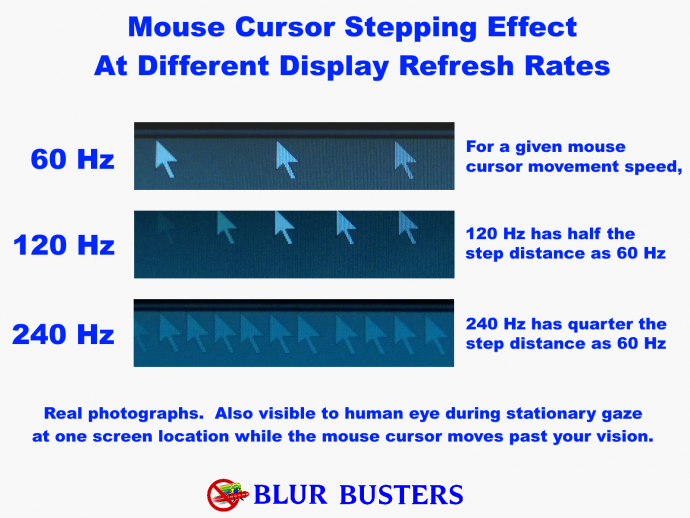
Strobing also amplifies the visibility of microstutter -- including mouse microstutters -- so you might want to use ~2000 Hz to brute force those harmonic/beat-frequency micro stuttering out (microstutters/jittery motion often a function of Hz-vs-Hz, or Hz-vs-fps beat-frequencying) -- part of why I don't like VSYNC OFF with low-Hz strobing, because jitter-feel is a known disadvantage of strobing unsynchronized frame rates.
theTDC wrote: ↑09 Mar 2021, 20:29
If persistence blur is a much bigger problem for 99% of the population, this could be very good, because I'm not very bullish on us ever getting the hardware capable of powering 10,000 Hz monitors, even if we eventually get the monitors themselves.
The
Vicious Cycle Effect affects how low/high a refresh rate becomes retina. Where you need more time to track eyes on fast high resolution moving objects, to notice its motion resolution limitations. The smaller the display, the less time you have to notice the motion resolution limitations of fast-moving objects that disappear off the edge of the screen more quickly.
Be warned, these are only example numbers/estimates and will vary greatly on a human's maximum eye-tracking speed:
- It's possible that smartphone displays become "retina refresh rate" at slightly below 1000 Hz for most people
- It's possible that desktop monitors become "retina refresh rate" at about ~2000 Hz for most people
- It's possible that 10,000 Hz is only needed as a retina refresh rate for full FOV displays like virtual reality headsets (or first row seating on a 16K-resolution IMAX/OMNIMAX screen)
The smaller the FOV and the lower the reoslution, the lower the "retina" point of refresh rate where no further benefits are derived.
theTDC wrote: ↑09 Mar 2021, 20:29
Frankly Moore's law has been dead for a very long time. While it's possible we might get 10x the GPU power by the end of the decade
We don't need 10x GPU power. We only need
Frame Rate Amplification Technology. My Oculus Rift VR headset laglessly converts 45fps to 90fps using ASW 2.0 as a depth-buffer-aware "smart 3D interpolation-like algorithm" that doesn't need latency because it is not a black-box interpolator. It just need motion vectors from 1000Hz controllers, to create intermediate frames.
Remember, when you watch Netflix, the Netflix streams at only 1 true frame per second, and Netflix is adding 23 "predicted frames" in between (essentially "fake frames" if you want to use lingo). It's not a bad wolf like interpolation because it's not black-box prediction, because the movie file knows what's ahead, and can accurately predict the next frame using math formulas to "fake" the in-between frames. Humans can't tell this.
Frame Rate Amplification Technology: No Longer Need To Render EVERY Frame
Video compression uses the system of I-Frame, B-Frame and P-Frame system of H.264 compression. Even H.EVC has something similar where

What's magically happening is that we're reworking the GPU workflow to add perceptually lossless frames in between original GPU rendered frames.
By the end of the decade (or next, at latest) we will have GPUs with dedicated frame rate amplification silicon that can laglessly convert 100fps to 1000fps without artifacts (even with processing overhead, it will still be less laggy than the original 100fps, because of the access to original 1000Hz+ movement data that removes the ugly soap opera effect guesswork of grandpa's LCD television). As flawless as those Netflix "fake-frames".
2:1 ratio frame rate amplification has already arrived to most PC-based virtual reality headsets, such as Oculus' Asynchronous Space Warp version 2.0 which is frankly, amazing for what it does. But 2:1 needs to become 5:1 and 10:1 to get 1000fps Unreal 5 by the end of this decade.
If you are fascinated by this, make sure to read
Frame Rate Amplification Tech -- more frame rate with fewer transistors simply by reworking the GPU workflow.
theTDC wrote: ↑09 Mar 2021, 20:29
our single thread CPU perf has improved just 13x since 2001, according to passmark, and I doubt it will pull another 13x increase in the next 100 years.
You're thinking old-fashioned. Frame rate amplification avoids this. We only need 100fps to get 1000fps. Today, my VR headset is already converting 45fps to 90fps almost flawlessly. No soap opera, no parallax artifacts, no super-lag feel. The Version 2.0 uses the Z-Buffer to eliminate the old parallax artifacts too, technology that is already on the market! VR is ahead of desktop gaming in frame rate amplification, for those who have been living under the rock about new methods of free frame rate.
In fact, I am cited on Page 2 of a research paper,
Temporally Dense Raytracing by NVIDIA -- a ray tracing version of frame rate amplification.
We've only begun to scratch the surface of frame rate amplification. We stop thinking like Issac Newton and now think like Albert Einstein -- GPU workflows is being reworked to say goodbye to "all-frames-must-be-original-frames". As long as we can make extra GPU frames as flawless as Blu-Ray "fake frames" (Blu-Ray also uses estimated frames in between the original P-Frames), without adding input lag. Frames visible for 1/1000sec can be estimated/extrapolated/interpolated/reprojected/whatever as long as it's perfect-looking to the human eyes. Imagine it as "retina interpolation" except it's not interpolation (more accurately "extrapolation") because it's not black box, because the frame rate amplifier knows about the 1000 Hz+ controller data, so it's not like it doesn't know the position of the next frame. So it doesn't need to be laggy and ugly like grandpa's Sony Motionflow of yesteryear.
theTDC wrote: ↑09 Mar 2021, 20:29
On top of that, when we start getting into 100 microseconds territory, we might have to completely re-architect our chips, since the memory latency time between the GPU and CPU is many multiples of our refresh rate. Heck, a single cache miss that takes ~100ns is an entire 0.1% of our frametime. Yikes.
We do need to rearchitect, but we only need to add frame rate amplification silicon, and the necessary APIs to feed it properly (movement data, controller data, physics data) so it can create the intermediate properly. We may still have, say, 2ms of processing latency to generate 1000fps, but 2ms is less lag than 100fps (10ms per frame). You see? So the lag goes down, but not down to 100 microseconds, as we pipeline those framerate-amplified frames concurrently over parallelized multicore frame rate amplification silicon.
Do you understand what I am getting at? We people are thinking outside the box these days

theTDC wrote: ↑09 Mar 2021, 20:29
I really don't think that any video game simulation is going to be able to be run at 10,000 Hz
We don't need 10,000 Hz for desktop monitors -- 10,000 Hz is only for 180-degree screens because of the
Vicious Cycle Effect.
The bigger FOV the screen, the higher the retina Hz is. The smaller FOV the screen, the lower the retina Hz is, because of less time to eye-track objects before it falls off the edge of the screen. Resolution plays a role, the higher resolution the easier to see. It's only when you've got retina-resolution 180-degree-FOV displays, that we need 10,000+ Hz to make it indistinguishable from real life.
Besides, 10,000 Hz will probably only be possible via parallelized frame rate amplification (e.g. large supercomputers connected to a VR headset). A main GPU would generate the intermediate frames, but daughter GPUs will process the individual framerate-amplified frames, with a high-speed supercomputer bus accepting the motion vector data from controllers (mouse, head tracking, keyboard, game physics, etc), to essentially 3D-extrapolate the frame perceptually flawlessly. Imagine one main controller GPU generating 100fps data, and 9 additional GPU cards parallelizing the in-between frames in a shingled-render manner. You may still have the same latency of 100fps original frame rate that way, but it's already doable at the enterprise level during shingled-rendering (+1ms offsets per parallized GPU running on a large custom made motherboard designed for enterprise applications), but requires custom programming today.
Tomorrow, it all filters down to decicated amplification silicon on the same GPU (fewer transitors than SLI per frame), so doing 10:1 ratio amplification will eventually only require twice to three times as many transitors as the original frame rate -- there are tricks already happening. To reduce transistor count even further, some of this will involve neural networks and artificial intelligence, though. Eventually some of this will filter down to consumer GPUs to increase frame rate amplification ratios to approximately 4:1 or 5:1 (up from 2:1), and then consequently to 10:1 ratios.
For retail level within 10-20 years, we should be able to achieve 1000fps frame rate amplification from 100fps. The way you replied to my post, suggests that you didn't read the bottom half of
Frame Rate Amplification Technology, so please read that first, before replying to this post -- amazing stuff is already happening in laboratories.
The important thing is that monolithic frame rendering is going the way of dinosaur in the next 1-2 decades, replaced by a multilayer parallized frame rate amplification system.
theTDC wrote: ↑09 Mar 2021, 20:29
at least if it's at the level of our modern games, no matter how far into the future we go. So if it ends up being that there is quite a worse epxerience with, say, 1,000 Hz monitors at 0.1ms persistence, versus outright 10,000 Hz monitors, I think that's just going to be too bad for gamers. And that's assuming they can even run some modern-type game at 1,000 Hz.
Strobed 1000 Hz will probably still be useful for 180-degree VR indeed, as stroboscopic effects will be extremely minor and only during ultra-fast-motion situations.
theTDC wrote: ↑09 Mar 2021, 20:29
Personally I don't really care about games, let alone modern ones, but I do care about real time 3D rendering, for things like architectural preview, interactive storytelling, and many others. I think there's lots of potential for those types of things, since the CPU simulation side is so trivial, so getting well in excess of 1,000+ Hz is really not that difficult.
As long as there's a high-frequency motion vector API to have the CAD tell the GPU to "rotate this scene 0.125 degrees along the Z axis at these co-ordinates", the GPU can frame-rate-amplify it without needing an original re-render (redrawing all those polygons/triangles).
Beyond 2030s+ we are not going to be rendering every single frame fully anymore at frame refresh rate stratospheres, it'll have more in common with a multi-tier hierarchy of macroblock video compression (except it'll be perceptually lossless, like a 36-bit-color 300+ megabit/sec H.EVC digital cinema file). We can't scale anymore with classical monolithic polygonal complete re-rendering every single frame; but we still need to do it at fairly high sample rates (100-200fps).
No Longer Need To Render EVERY Frame: Perceptually Lossless & Lagless "Predicted Frames" Are Now Possible in Real Time GPU-3D (metaphorical 3D-GPU equivalent of Netflix and Blu-Ray predicted P-Frames and B-Frames)
You see, 200fps and 5ms timescales, also means the intermediate frames can now be perceptually losslessly filled very, very, very quickly in with some algorithms we've all successfully come up with. Some methods require display-side GPUs (to eliminate the bandwidth explosion on display cable), while other methods simply rearchitecture it and uses descendants of perceptually lossless display stream compression, to get ultra-refresh-rates at ultra-resolutions, from computer to display.
It will take about ~10 years to be reality at the 1000fps scales, but there's nothing inherently stopping further progress. It's kind of the framebuffer-workflow equivalent of going from single core processors to multi core processors -- videogames will still render at only 100-200fps(ish), but it'll be UE5-quality at 1000fps+ instead on the display because of the new frame rate amplification pipelines.
theTDC wrote: ↑09 Mar 2021, 20:29
Frankly it's outright trivial. Once we spawn an avatar in there, and start with some rudimentary collision detection, interactions (like opening a door), it should still be very easy to run in excess of 1,000 Hz. With ~2004 era graphics, I think such scenes/workloads are already limited by the monitors we have to display them.
TL;DR: Good News: There's an eventual engineering path to UE5+ graphics at 1000fps+, see above
(But yes, we'll still have to use strobing for now. You'll just be upgrading again in a decade.)