

Correct.braavosraider wrote: ↑27 Jan 2021, 16:27My question is what kind of lag/latency do you refer to when the fps fluctuating (example : between 100-250 fps), as I read somewhere you said that 60 fps at 240hz has better input lag than 60 fps at 60hz?
The faster scanout (see High Speed Videos of LCD refreshing) means 60fps at 240Hz has less lag than 60fps at 60Hz. And to complicate matters, 60fps at 60Hz on a 240Hz panel sometimes has worse latency than 60fps at 60Hz on a 60Hz panel. But 60fps at 240Hz on a 240Hz panel beats all of them (assuming same display buffering latency + GtG latency)
Now, in a different part of the latency chain, frametime itself is a GPU processing latency (100fps = 1/100sec for GPU to render frame). A fluctuating frame rate can mean fluctuating GPU latency (of the latency chain), which is why some players love to cap to stabilize the frame rate.
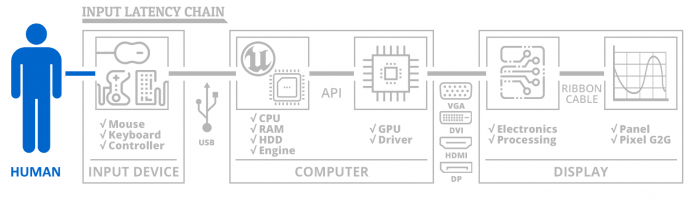
There are pros/cons, because a higher framerate is lower lag, but sometimes if the framerate fluctuates too much, the frametime latency can add a latency inconsistency factor -- if you're pretrained to aim at a higher framerate or lower framerate, the changed GPU latency may mean missed shots at a different framerate due to changed frametime latency.
(100fps = 1/100sec frametime = 10ms GPU latency)
(200fps = 1/200sec frametime = 5ms GPU latency).
So with a latency yo-yo effect can affect your aiming sometimes. So seeing framerates gyrate 50fps through 300fps, you might have difficulty. So sometimes capping in the middle of your framerate fluctuation range, can stabilize the latency to be more predictable, even if your average latency is maybe a millisecond more, at least the latency is staying stable.
Different players will have different preferences on how they prefer to cap. YMMV.


