Some reviewers do a great job, and other reviewers do a poor job.
I prefer that reviewers publish the sync track.
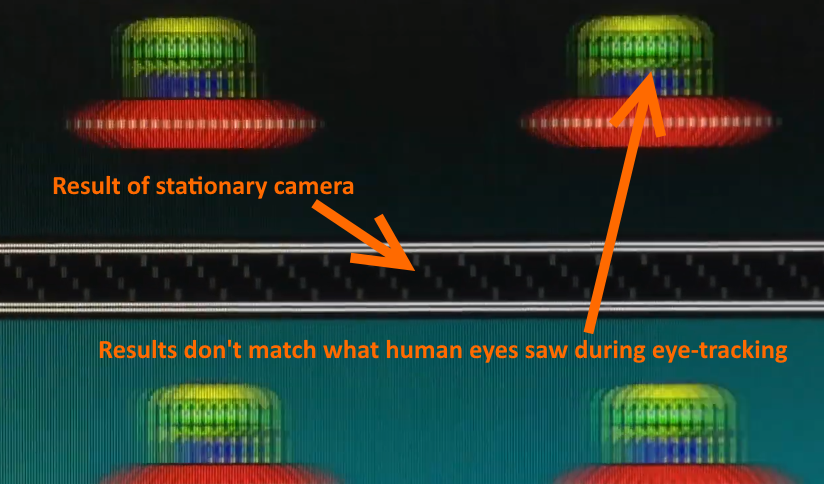
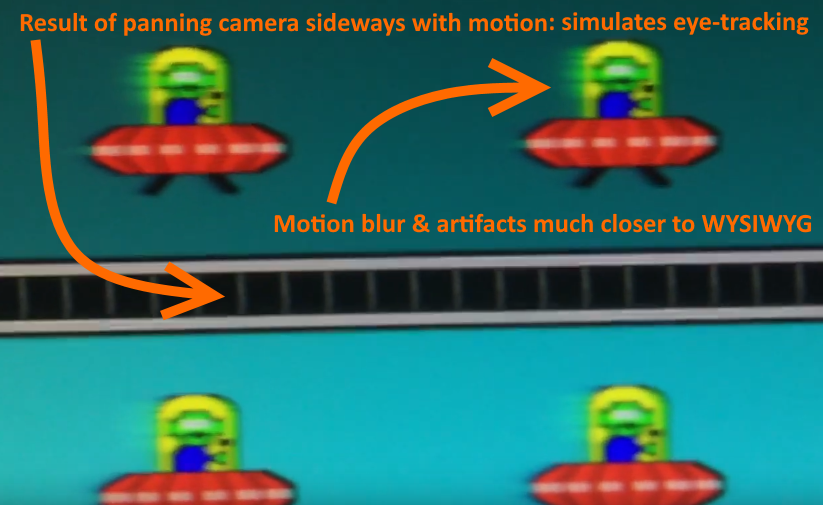
For those wondering, use the tooltips at
www.testufo.com/ghosting
Click on the labels to make the tooltips appear, to help teach you about how to do it.
They will help explain things better.

- Screenshot 2026-02-15 at 5.40.56 PM.png (49.9 KiB) Viewed 13639 times

- Screenshot 2026-02-15 at 5.40.59 PM.png (122.73 KiB) Viewed 13639 times

- Screenshot 2026-02-15 at 5.41.02 PM.png (144.07 KiB) Viewed 13639 times

- Screenshot 2026-02-15 at 5.41.05 PM.png (57.96 KiB) Viewed 13639 times

- Screenshot 2026-02-15 at 5.41.10 PM.png (1.03 KiB) Viewed 13639 times

- Screenshot 2026-02-15 at 5.40.52 PM.png (121.71 KiB) Viewed 13639 times

- Screenshot 2026-02-15 at 5.43.23 PM.png (41.59 KiB) Viewed 13638 times


Also we have a
Pursuit Camera Forum
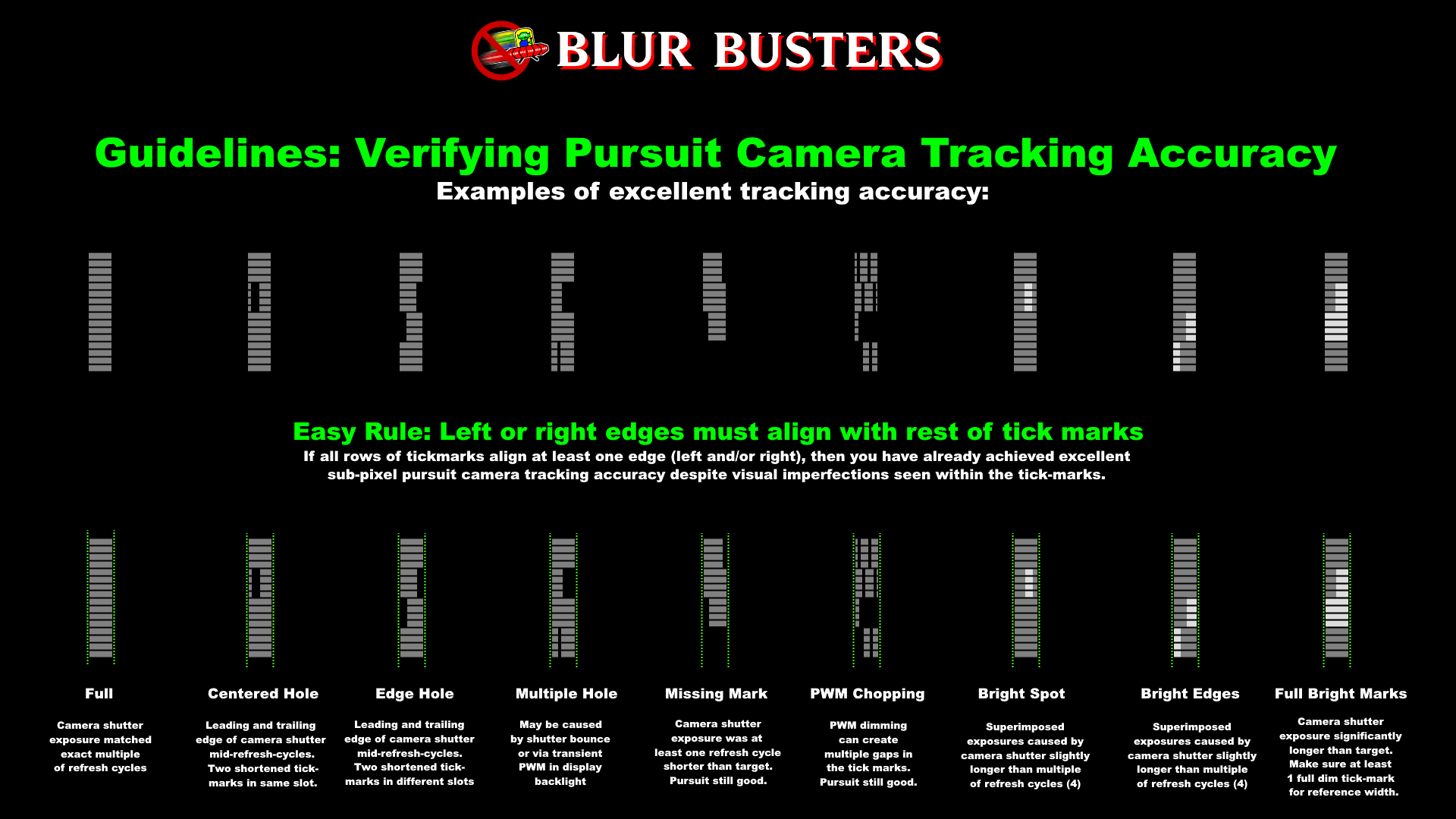
Use a shutter speed of refresh cycle count equal to tick marks.
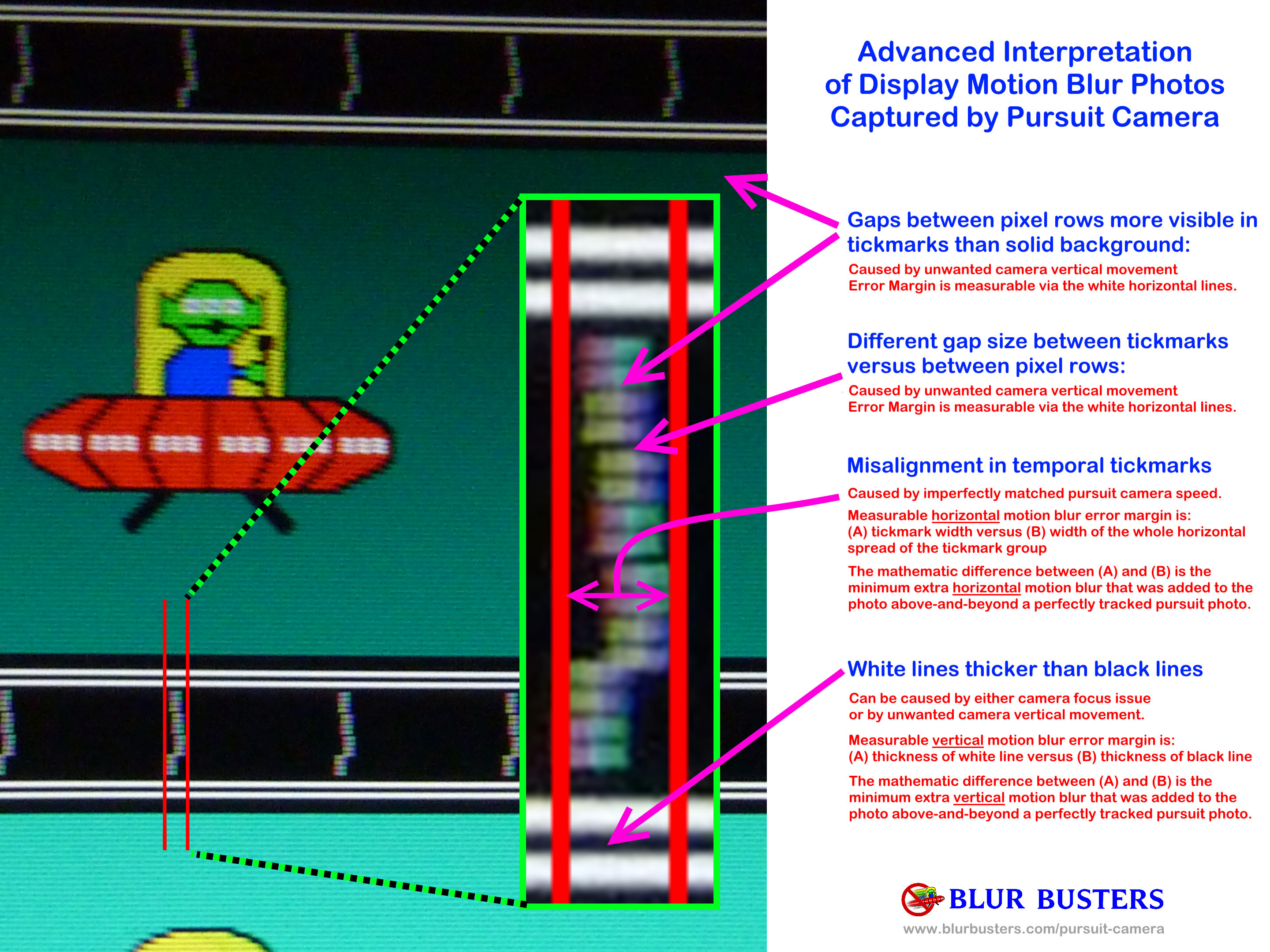
The sync track is the ground truth proof of accurate tracking over the camera exposure.
- Some people use camera rails
- Others people use handwave technique (video as burst shoot).
Handwave technique is now valid with good technique and an optically stabilized camera -- good for convention field tests -- I did handwave on an iPhone 14 at CES 2025 for the 480Hz OLED at www.blurbusters.com/120vs480 -- since video is like 1000 photographs (brute force) and sometimes 1 out of 1000 is clear (thanks to camera optical stabilization in high end smartphones). I used "DSLRCamera" app, fixed shutter speed to recommendation, held the phone landscape with both arms outstretched, stiff shoulders + locked elbows, and twisted using my waist to pursuit (not moving hands, but moving my waist), lens 18" from screen, pinch zoom a bit so I could see the preview clearly to aim the sync track clarity on the preview. Back and fourth about 3-4 times, then scroll through video in post-process, save clearest freezeframe. It can outperform flimsy shaky tripods for quick and dirty field tests, if you're professional at the waist-twist stiff-both-arms technique.
A slow shutter speed is intentional to simulate human vision integration time.
If pictures are sharp despite a slow-shutter moving camera, the display did a good job of blur busting so well that it avoided camera blur (despite a moving camera and slow shutter).
But the sync track has to look correct, as per standard.
It's the ground truth embedded in scientific results -- clever invention to embed tracking accuracy in the photograph -- so it doesn't care HOW you pursuited the camera (rail, wheels, slider, handwave), it TELLS you how accurately the photograph was in tracking the motion -- and that's what matters.
I have to tell you, trying to herd 1000 enthusaic content creators is like herding 1000 cats, it's not easy. So some will do it well, and some will do it poorly. But and it's indeed best that they all show the sync track. By sharing your sync track, you are boasting honesty and the truth of your tracking, so it's very good when you do show the sync track because it's the proof of accurate camera tracking.
It's a
peer-reviewed invention in a conference paper, too.
